
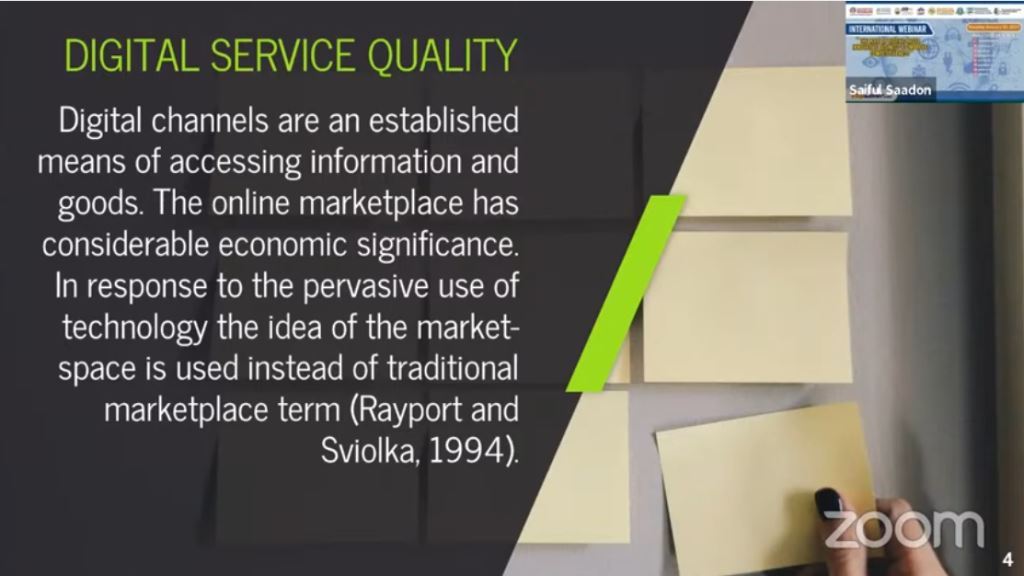
Digital channels are a well-established means of accessing information and goods. The online market has considerable economic significance. In response to the widespread use of technology, the idea of market space is used instead of the term traditional market (Rayport and Sviolka, 1994).
Digital Services and Digital Government do not mean the same thing; however, because the two share a common theme, government organizations often place them together. As a result, Digital Services and Digital Governance may be confused or used interchangeably within public government organizations.
Service quality (SQ), in its contemporary conceptualization, is the comparison of perceived expectations (E) of a service with perceived performance (P), giving rise to the equation SQ=P-E. This conceptualization of service quality stems from the expectation-disconfirmation paradigm.
Businesses with high service quality will meet or exceed customer expectations while remaining economically competitive. Evidence from empirical studies shows that improving service quality improves long-term profitability and economic competitiveness. Improving service quality can be achieved by improving operational processes; identify problems quickly and systematically; establishing valid and reliable service performance measures as well as measuring customer satisfaction and other performance outcomes.
The main concern of managers has always been to find ways to reduce business costs. Digital transformation, especially the use of cloud services, allows companies to reduce operational costs significantly. Digital Services often enable one-stop and comprehensive online services for citizens and businesses by linking the various services offered by various institutions. In addition, increasing the ease of information sharing between individual agencies (to the point permitted by law) results in better and/or new services. For example, the administration of justice would be faster and more cost-effective if the information systems of different agencies under the criminal justice system (police, procuratorate, procuratorate, courts, prisons) were able and able to share data.
Using Digital Services enables organizations to reduce or even eliminate local IT infrastructure, reduce the volume of manual administration costs, and save physical space regarding paper and asset storage. Digital Services can also provide cost savings by streamlining services. For example, the TUO (Tell Us Once) principle can help ease the administrative burden, especially for public bodies. Exchange of collected information is less costly and less burdensome than collecting and storing it repeatedly. In addition, some experts believe that data protection issues can be better accounted for due to less data management. Process optimization and potential for higher administrative efficiency are described as TUO's main advantages for public administration. These include fewer calls to customer service centers, fewer paper-based applications, faster processing of administrative processes, time savings due to reduced data retrieval requirements and less data errors due to data reuse. This can save public administration costs and improve the quality of various public services. Application of the TUO principle across borders can also help ensure equal treatment of domestic and foreign persons and companies in the use of public services, which are required to provide information to public authorities. Lastly, the TUO can help the GC to focus more on the core mandate as staff become less preoccupied with administrative burdens.
The above material was presented by presenters from Malaysia in an international webinar held by STEKOM University in collaboration with Universities from Pakistan, Malaysia, and various other parties. The name of the presenter is DR. Saiful izwaan Bin Saadon who is a senior lecturer at the faculty of maritime studies, Universiti Malaysia Terengganu. The title of the presentation is "Service Quality For Digital Based Innovation Business As A Tool For Customer Satisfaction".
This international webinar activity is part of the implementation of STEKOM University's commitment to increase various international activities. This was done in order to realize the vision to become an international-class university. Various international activities carried out by STEKOM University continue from year to year. There are international activities that are sustainable and there are also some international activities that are not sustainable. All types of international activities are accommodated and regulated by the International department of STEKOM University.
International Webinar 2023 - The Role of Digital Based Innovative to Improve Competitiveness – Part 26
International Webinar
Back to News
International Webinar
Thursday, February 16, 2023
Priyadi, S.Kom, M.Kom
0 Views