
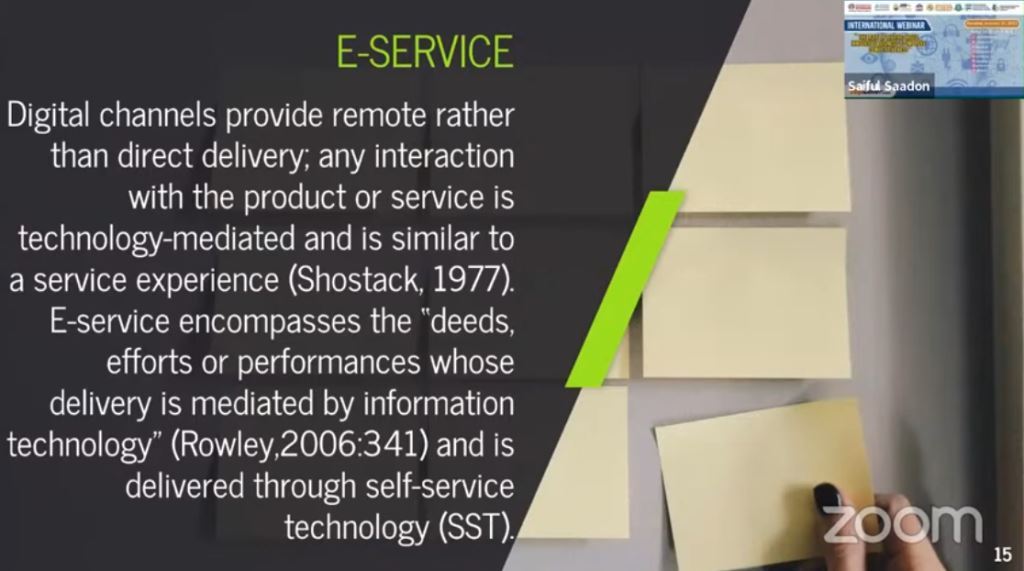
Electronic Service Systems or E-services (English: Electronic Services, abbreviated as E-Services) is one of the leading applications utilizing Information and Communication Technology (ICT) in different areas. However, a precise definition of e-service is difficult to come by and some researchers have used different definitions to describe e-service. Although these definitions differ, it can be said that they all agree on the role of technology in facilitating services which makes them more than electronic services.
According to Rowley (2006) electronic services are defined as: "... actions, efforts or performances whose delivery is mediated by information technology. These electronic services include elements of e-tailing services, customer support, and service ". This definition reflects three main components- service provider, service recipient and service channel (ie, technology). For example, as pertaining to public e-services, the public body is the service provider and the citizens and businesses receiving the service. Service channels are the third requirement of electronic services. The Internet is the main channel of electronic service delivery while other classic channels are also considered (eg telephone, call centers, public kiosks, mobile phones, television).
Since its beginning in the late 1980s in Europe and formally recognized in 1993 by the US Government, the term 'E-Government' has now become one of the recognized research domains especially in the context of public policy and has now acquired strategic importance in the modernization of the public sector. public. e-services is another branch of the domain and attention has also been growing among practitioners and researchers.
Electronic services (or e-Services) is a very generic term, usually referring to "Provision of services via the Internet (the prefix stands for 'e-electronics', as in other usages), so electronic services may also include Internet commerce, but may also include non-services. -commercial (online), which is usually provided by the government (Alexei Pavlichev & G. David Garson, 2004: 169-170; Muhammad Rais & Nazariah, 2003: 59, 70-71).
'Electronic services are online services available on the Internet, where valid transactions to buy and sell (procurement) are possible, as opposed to traditional websites, where only descriptive information is available, and no online transactions are possible.' (Jeong, 2007).
The term 'electronic services' has many applications and can be found across many disciplines. The two dominant application areas of electronic services: 'E-Business' (or electronic commerce): electronic services provided mostly by businesses or Non-governmental Organizations (NGOs) (private sector).
'E-government': electronic services provided by the government to citizens or businesses (public sector is the supply side). Use of and description of e-services on this page is limited to the context of 'e-government' only where e-services are usually associated with the prefix "public": Public e-services. In some cases, we have to describe aspects related to both fields such as some conferences or journals that cover the concept of "electronic services" in both the domains 'e-government' and e-business.
The above material was presented by presenters from Malaysia in an international webinar held by STEKOM University in collaboration with Universities from Pakistan, Malaysia, and various other parties. The name of the presenter is DR. Saiful izwaan Bin Saadon who is a senior lecturer at the faculty of maritime studies, Universiti Malaysia Terengganu. The title of the presentation is "Service Quality For Digital Based Innovation Business As A Tool For Customer Satisfaction".
This international webinar activity is part of the implementation of STEKOM University's commitment to increase various international activities. This was done in order to realize the vision to become an international-class university. Various international activities carried out by STEKOM University continue from year to year. There are international activities that are sustainable and there are also some international activities that are not sustainable. All types of international activities are accommodated and regulated by the International department of STEKOM University.
International Webinar 2023 - The Role of Digital Based Innovative to Improve Competitiveness – Part 28
International Webinar
Back to News
International Webinar
Thursday, February 16, 2023
Priyadi, S.Kom, M.Kom
0 Views