
The Digital Revolution (also known as the Third Industrial Revolution) was the shift from mechanical and analogue electronics to digital electronics that began in the latter half of the 20th century, with the adoption and proliferation of digital computers and digital record keeping, which has continued to the present day.[1] Implicitly, the term also refers to the major changes brought about by digital computing and communication technologies during this period. From the analogy of the Agricultural Revolution (Neolithic) and the First Industrial Revolution (1770-1840), the Digital Revolution marked the start of the Information Age.
Central to this revolution is the mass production and widespread use of digital logic, MOSFETs (MOS transistors), integrated circuit (IC) chips, and the technologies derived from them, including computers, microprocessors, digital cellular telephones, and the Internet. This technological innovation has changed traditional production and business techniques. The Third Industrial Revolution will be followed by the Fourth Industrial Revolution.
Important basic technologies invented in the last quarter of the 19th century, including Charles Babbage's Analytical Engine and the telegraph. Digital communications became economical for widespread adoption after the invention of the personal computer. Claude Shannon, a Bell Labs mathematician, is credited with having laid the foundations of digitization in his 1948 pioneering article, A Mathematical Theory of Communication. The digital revolution changed technology from analog format to digital format. By doing this, it is possible to make a copy identical to the original. In digital communications, for example, repeating hardware is capable of amplifying a digital signal and transmitting it without losing the information in the signal. As important as the revolution is the ability to easily move digital information between media, and to access or distribute it remotely.
The turning point of the revolution was the change from analog music to digital recordings. During the 1980s the digital optical compact disc format gradually replaced analog formats, such as vinyl records and cassettes, as the popular media of choice.
At the end of 2005, the Internet population reached 1 billion, and 3 billion people worldwide were using mobile phones at the end of the decade. HDTV became the standard television broadcast format in many countries by the end of the decade. In September and December 2006 respectively, Luxembourg and the Netherlands became the first countries to completely switch from analog to digital television. In September 2007, the majority of US survey respondents reported having broadband internet at home. According to estimates from Nielsen Media Research, approximately 45.7 million US households in 2006 (or about 40 percent of an estimated 114.4 million) owned a dedicated home video game console, and in 2015, 51 percent of US households owned a video game console. custom home games according to the Entertainment Software Association's annual industry report. In 2012, more than 2 billion people used the Internet, double the number using it in 2007. Cloud computing had entered the mainstream in the early 2010s. In January 2013, the majority of US survey respondents reported owning a smartphone. In 2016, half of the world's population was connected and by 2020, that number had increased to 67%.
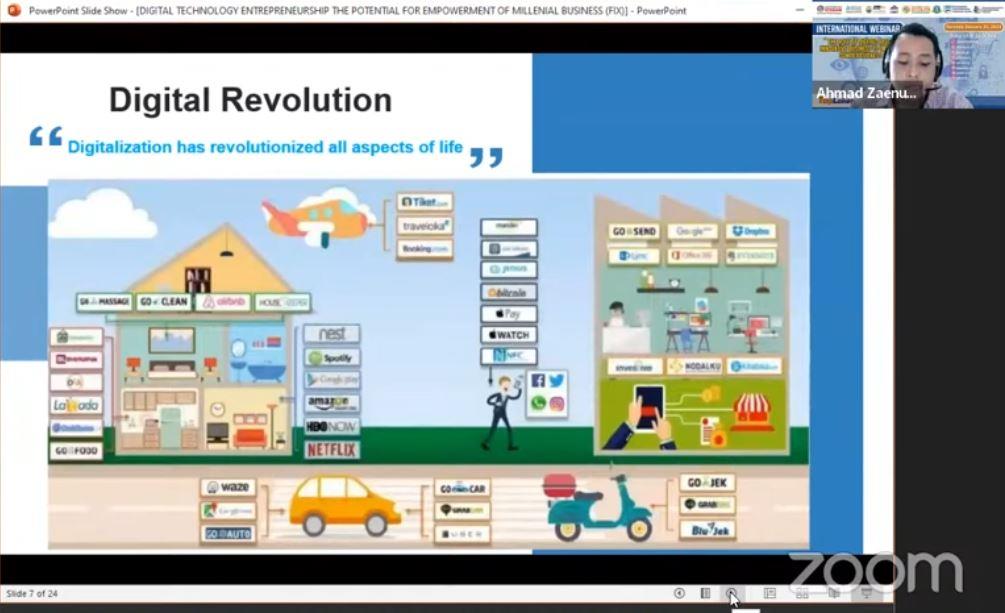
The above material was presented by presenters from Indonesia in an international webinar held by STEKOM University in collaboration with Universities from Pakistan, Malaysia, and various other parties. The name of the presenter is Achmad Zaenuri who is a lecturer at STEKOM University and is the head of the entrepreneurship study program.
This international webinar activity is part of the implementation of STEKOM University's commitment to increase various international activities. This was done in order to realize the vision to become an international-class university. Various international activities carried out by STEKOM University continue from year to year. There are international activities that are sustainable and there are also some international activities that are not sustainable. All types of international activities are accommodated and regulated by the International department of STEKOM University.
International Webinar 2023 - The Role of Digital Based Innovative to Improve Competitiveness – Part 4
International Webinar
Back to News
International Webinar
Sunday, February 5, 2023
Priyadi, S.Kom, M.Kom
0 Views