
Collaboration (from Latin com- "with" + laborare "to labor", "to work") is the process of two or more people, entities or organizations working together to complete a task or achieve a goal. Collaboration is similar to cooperation. Most collaboration requires leadership, although this form of leadership can be social in decentralized and egalitarian groups. Teams that work collaboratively often access greater resources, recognition, and rewards when faced with competition for limited resources.
Structured collaboration methods encourage introspection of behavior and communication. The method aims to increase team success when they engage in collaborative problem solving. Collaboration comes in the opposite sense which denotes the idea of adversarial collaboration, although this is not a common use of the term. In its applied sense, "(a) collaboration is a purposeful relationship in which all parties strategically choose to work together to achieve a common outcome."
Trade is a form of cooperation between two societies that produce different portfolios of goods. Trade began in prehistoric times and continues because it benefits all its participants. Prehistoric peoples exchanged goods and services with one another without modern currency. Peter Watson recorded the history of long-distance trading about 150,000 years ago. Trade exists because different communities have a comparative advantage in the production of tradable goods.
Collaboration within indigenous peoples, particularly in the Americas, often involves the entire community working toward a common goal in a horizontal structure with flexible leadership. Children in some Native American communities collaborate with adults. Children can become contributors in the process of achieving goals by taking on tasks that match their skills.
Indigenous learning techniques consist of Learning by Observing and Pitching In. For example, the study of Mayan fathers and children with traditional Indigenous ways of learning worked together in collaboration more often when building 3D model puzzles than Mayan fathers with western schools. Additionally, the Chillihuani people of the Andes value work and organize work parties in which members of every household in the community participate. Children from the traditional heritage community willing to help around the house voluntarily.
In the Mazahua Indigenous community in Mexico, school children show initiative and independence by contributing to their class, completing activities throughout, assisting and correcting their teacher during lectures when things go wrong. Fifth and sixth graders in community working with teacher installing classroom windows; the installation becomes a class project in which students participate in the process alongside the teacher. They all work together without needing leadership, and their movements are all in sync and flow. This is not a teaching process, but rather a hands-on experience in which students work together as a synchronous group with the teacher, switching roles and sharing assignments. In this community, collaboration is emphasized, and students are trusted to take the initiative. While one worked, the others watched closely and all were allowed to attempt tasks at more experienced paces to complete more complex sections, while the others watched intently.
The material above was delivered by a presenter from Ukraine in a visiting lecturer held by STEKOM University in collaboration with Universities from Ukraine. The title of the presentation is "Learning Skills in 21st Century Education and Work Environment".
This international webinar activity is part of the implementation of STEKOM University's commitment to increase various international activities. This was done in order to realize the vision to become an international-class university. Various international activities carried out by STEKOM University continue from year to year. There are international activities that are sustainable and there are also some international activities that are not sustainable. All types of international activities are accommodated and regulated by the International department of STEKOM University.
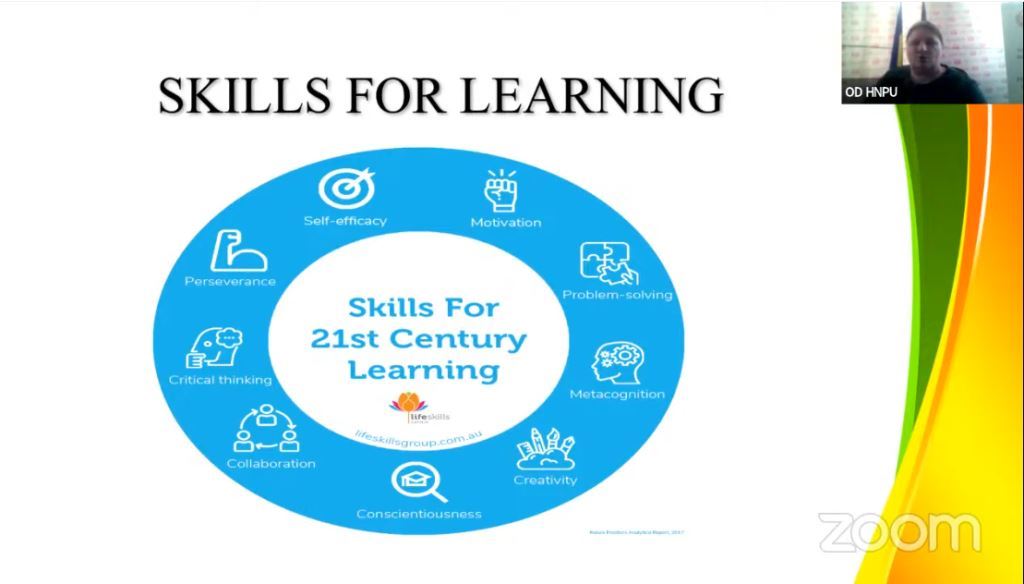
International Webinar 2023 - Visiting Lecture with Lecturer from Hlukhiv National Pedagogical University (Ukraine) – Part 11
International Webinar
Back to News
International Webinar
Sunday, February 26, 2023
Priyadi, S.Kom, M.Kom
0 Views