
In psychology, self-efficacy is an individual's belief in their
ability to act in the way necessary to achieve a certain goal. The
concept was originally proposed by psychologist Albert
Bandura.
Self-efficacy affects every area of human
endeavor. By determining the beliefs a person holds about their power
to influence situations, self-efficacy greatly influences both the
power a person has to face challenges competently and the choices a
person is most likely to make. This effect is particularly clear, and
interesting, with respect to investment behavior such as in health,
education, and agriculture.
A strong sense of
self-efficacy drives human achievement and personal well-being.
Someone with high self-efficacy sees challenges as things to be
mastered rather than threats to be avoided. These people can recover
from failure more quickly and are more likely to attribute failure to
a lack of effort. They approach threatening situations believing they
can control them. These things have been linked to lower stress
levels and a lower susceptibility to depression.
In
contrast, people with low self-efficacy perceive difficult tasks as
personal threats and avoid them. Difficult tasks lead them to look at
the skills they have rather than the skills they have. It is easy for
them to lose faith in their own abilities after experiencing failure.
Low self-efficacy can be associated with higher levels of stress and
depression.
For low achieving students,
self-efficacy is not a self-fulfilling prophecy. Excessive efficacy
or 'illusory' efficacy hinders critical examination of one's
practice, thereby hindering professional learning. One study,
involving 101 lower division Portuguese students at U.T. Austin,
examines foreign students' beliefs about learning, achieving goals,
and motivation to continue learning a language. It was concluded that
excessive efficacy affected students' motivation negatively, so that
students who believed they were "good at languages" had
lower motivation to learn.
Self-efficacy has proven
to be very useful for helping undergraduate students gain insight
into their career development in the STEM field. Researchers have
reported that mathematics self-efficacy is more predictive of
mathematics interest, choice of mathematics-related subjects, and
mathematics major than past achievement in mathematics or outcome
expectations.
Self-efficacy theory has been applied
to career areas to examine why women are underrepresented in
male-dominated STEM fields such as math, engineering, and science. It
was found that gender differences in self-efficacy expectations
significantly influence career-related behaviors and career choices
of young women.
Technical self-efficacy was found to
be an important factor for teaching computer programming to school
students, as students with higher levels of technological
self-efficacy achieved higher learning outcomes. The technical
self-efficacy effect was found to be stronger than the gender
effect.
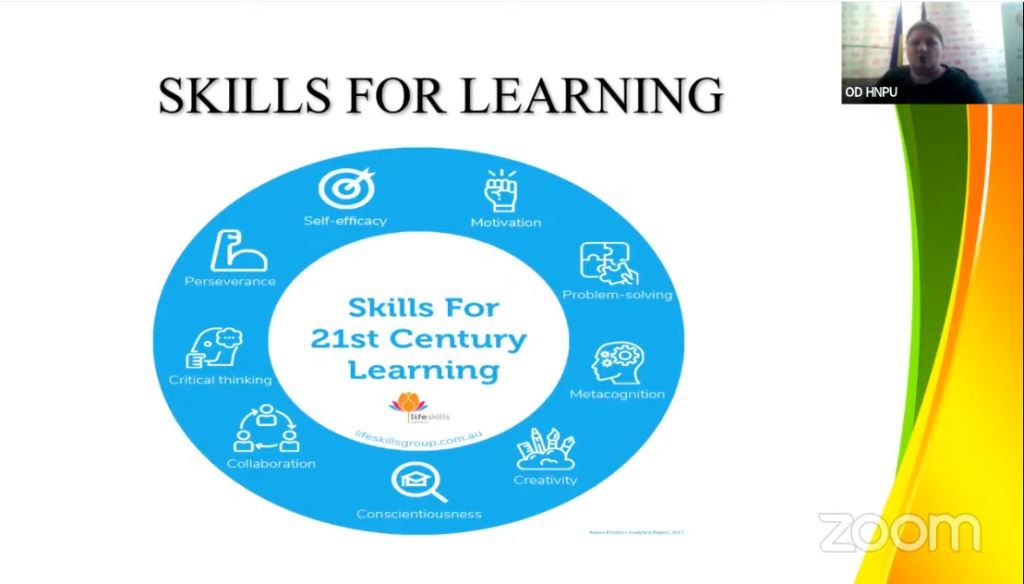
The above material was delivered by a
presenter from Ukraine in a visiting lecturer held by STEKOM
University in collaboration with Universities from Ukraine. The title
of the presentation is "Learning Skills in 21st Century
Education and Work Environment".
This
international webinar activity is part of the implementation of
STEKOM University's commitment to increase various international
activities. This was done in order to realize the vision to become an
international-class university. Various international activities
carried out by STEKOM University continue from year to year. There
are international activities that are sustainable and there are also
some international activities that are not sustainable. All types of
international activities are accommodated and regulated by the
International department of STEKOM University.
International Webinar 2023 - Visiting Lecture with Lecturer from Hlukhiv National Pedagogical University (Ukraine) – Part 5
International Webinar
Back to News
International Webinar
Tuesday, February 21, 2023
Priyadi, S.Kom, M.Kom
0 Views