
Creativity is a phenomenon where something new and valuable is formed. The items created may be intangible (such as an idea, scientific theory, musical composition, or joke) or a physical object (such as an invention, printed literary work, or painting).
Scientific interest in creativity is found in a number of disciplines, most notably psychology, business studies, and cognitive science. However, it can also be found in education, humanities (philosophy, arts) and theology, social sciences (sociology, linguistics, economics), engineering, technology and mathematics. This discipline covers the relationship between creativity and general intelligence, personality types, mental and neural processes, mental health, artificial intelligence; the potential for fostering creativity through education, training, leadership, and organizational practices; the factors that determine how creativity is valued and perceived; fostering creativity for the benefit of the national economy; and the application of creative resources to enhance the effectiveness of teaching and learning.
James C. Kaufman and Beghetto introduced the "four C's" model of creativity; mini-c ("transformative learning" involving "personally meaningful interpretation of experience, action, and insight"), little-c (everyday problem solving and creative expression), Pro-C (demonstrated by creative people professionally or vocationally although not always excelling) and Big-C (creativity is considered great in a particular field). This model is intended to help accommodate models and theories of creativity that emphasize competence as an essential component and the historical transformation of the creative domain as the highest mark of creativity. It also, according to the authors, makes for a useful framework for analyzing creative processes in individuals.
Contrasting the terms "Big C" and "Little C" has been widely used. Kozbelt, Beghetto, and Runco use the little-c/Big-C model to review the main theories of creativity. Margaret Boden distinguishes between h-creativity (historical) and p-creativity (personal).
Robinson and Anna Craft have focused on creativity in the general population, particularly with regard to education. Craft makes a similar distinction between "high" and "small c" creativity and quotes Ken Robinson as referring to "high" and "democratic" creativity. Mihaly Csikszentmihalyi has defined creativity in terms of individuals who are judged to have made a significant creative contribution, perhaps changing domains. Simonton has analyzed the career trajectories of top creatives to map patterns and predictors of creative productivity.
Lin and Vartanian developed a framework that provides an integrative neurobiological description of creative cognition. This interdisciplinary framework integrates theoretical principles and empirical results from neuroeconomics, reinforcement learning, cognitive neuroscience, and neurotransmission research on the locus coeruleus system. It describes how decision-making processes studied by neuroscientists as well as activity in the locus coeruleus system underlies creative cognition and the dynamics of large-scale brain networks associated with creativity. This shows that creativity is a matter of optimizing and maximizing utility which requires individuals to determine optimal ways to exploit and explore ideas (the multi-armed bandit problem). This utility maximization process is thought to be mediated by the locus coeruleus system and this creativity framework describes how the tonic and phasic activities of the locus coerulues work together to facilitate the exploitation and exploration of creative ideas. This framework not only explains previous empirical results but also makes new and falsifiable predictions at various levels of analysis (ranging from neurobiological to cognitive and personality differences).
Skinner associated creativity with involuntary behavior that is reinforced by the environment. Spontaneous behavior performed by living things reflects learned behavior in the past. In Karen Pryor's book Don't Shoot the Dog she refers to how she strengthens dolphins to display new behaviors. This is what those who are creative and those who value creativity can relate to. A behaviorist might say that prior learning causes new behaviors to be reinforced many times and that individuals have been shaped to produce increasingly new behaviors. A creative person, according to this definition, is someone who is reinforced for new behavior more often than others. Behaviorists also suggest that anyone can be creative, they just need to be reinforced to learn to produce new behaviors.
The material above was delivered by a presenter from Ukraine in a visiting lecturer held by STEKOM University in collaboration with Universities from Ukraine. The title of the presentation is "Learning Skills in 21st Century Education and Work Environment".
This international webinar activity is part of the implementation of STEKOM University's commitment to increase various international activities. This was done in order to realize the vision to become an international-class university. Various international activities carried out by STEKOM University continue from year to year. There are international activities that are sustainable and there are also some international activities that are not sustainable. All types of international activities are accommodated and regulated by the International department of STEKOM University.
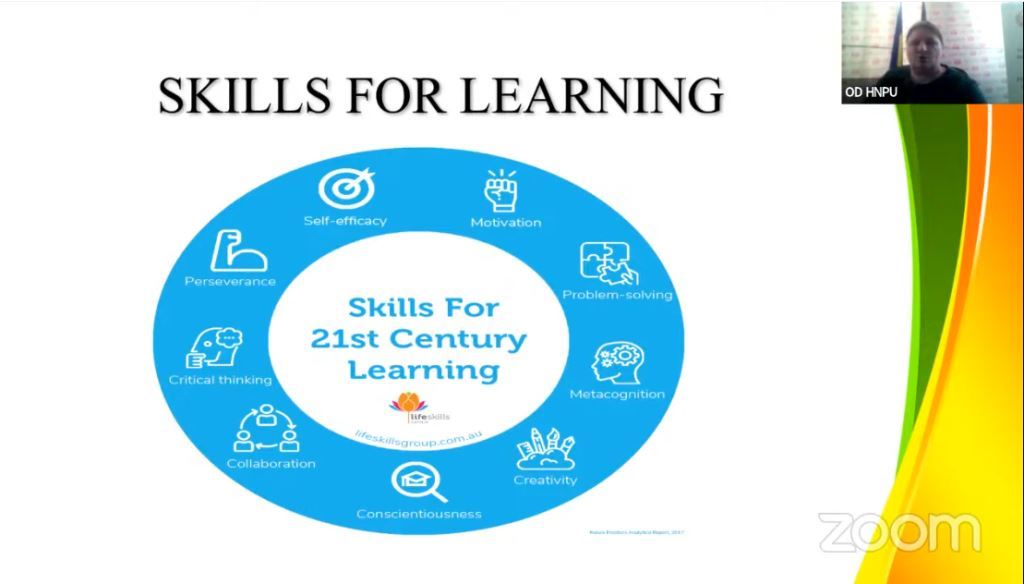
International Webinar 2023 - Visiting Lecture with Lecturer from Hlukhiv National Pedagogical University (Ukraine) – Part 9
International Webinar
Back to News
International Webinar
Sunday, February 26, 2023
Priyadi, S.Kom, M.Kom
0 Views