
The development of information technology today is very helpful in the company's business. However, if we don't understand the type of technology needed, we might make the wrong choice of technology. Especially in the field of decision making for companies, there is one information technology product that is very helpful, namely a decision support system.
STEKOM University's efforts to have a global reach include holding webinars on an international scale. On this occasion we will discuss an international webinar held by STEKOM University in which one of the speakers is a professor from the United States. The resource person is Kaushik Dutta who is a Professor and School Director at the University of South Florida. Professor Dutta in his presentation delivered material on decision support systems which are IT products that are very useful in corporate business.
The material presented by Professor Dutta includes Framework, Applications for Business, Techniques, and Infrastructure. Because the material presented is quite long, the news article that discusses Professor Dutta's presentation is divided into several parts. We are currently entering part 4. If the reader wants to know the previous presentation, please see some previous parts in the same article title.
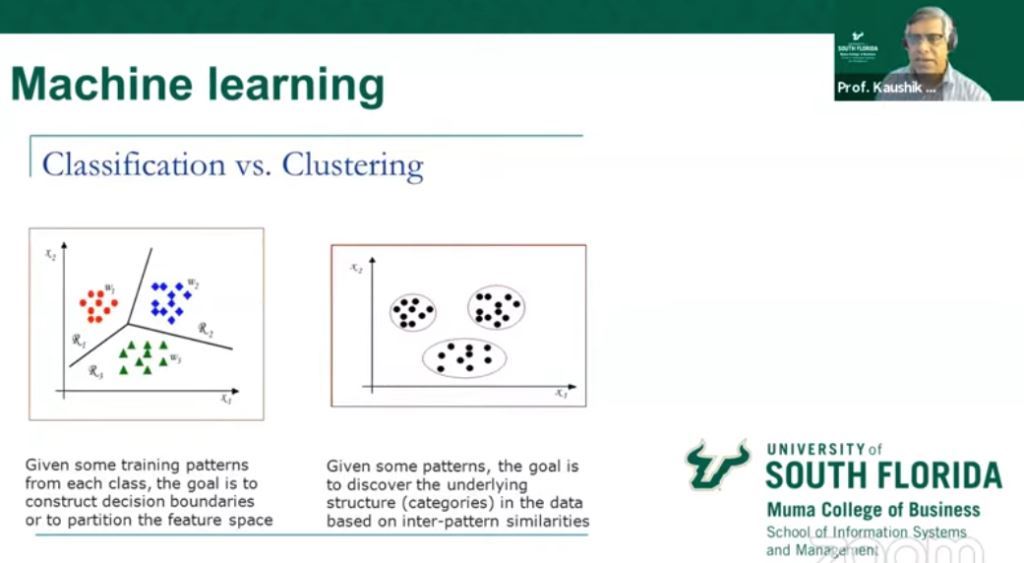
Continuing from the previous part, Professor Dutta then explained about the data analysis technique approach. In the explanation, there are two techniques, namely:
- Machine learning (Supervised and Unsupervised)
- Statistical Approach
In the machine learning approach, in Professor Dutta's explanation, one example is a decision tree. A decision tree is a machine learning algorithm that uses a set of rules to make decisions with a tree-like structure that models possible outcomes, resource costs, utility and possible consequences or risks. The concept is to present the algorithm with conditional statements, which include branches to represent decision-making steps that can lead to favorable outcomes.
Where each branch represents the result for the attribute, while the path from the leaf to the root represents the rule for classification. That's why this algorithm is called a decision tree because the choices branch off, forming a structure that looks like a tree. You can create a decision tree either vertically or horizontally depending on your preferences. Reads a horizontal decision tree from left to right and a vertical decision tree from above down.
There are two reasons why we use decision tree algorithms; 1) Decision trees usually imitate human thinking skills when making decisions, so they are easy to understand; 2) The logic behind the decision tree can be easily understood because it shows a tree-like structure.
Meanwhile, some shortcomings in the decision tree algorithm are 1) It is unstable, this is one of the limitations of the decision tree algorithm when small changes in the data can result in large changes in the decision tree structure; 2) Less effective in predicting the outcome of continuous variables.
Weaknesses and advantages of the decision tree algorithm can be considered based on the case being faced and the previous technology used in the company. If the variables in the case at hand tend to be constant and do not change, then this algorithm is very suitable to be implemented. However, if the characteristics of the variables are changing, then you should avoid using this algorithm so that later there will be no hassles when there are changes in variables when the system is used.
The Decision tree algorithm is quite easy to understand for beginners. For readers who are beginners in studying data analysis or machine learning, this algorithm is very suitable to be used as an example of the algorithm that was studied at the beginning. After studying this algorithm, we can study other algorithms that are more complex and functional in different cases.
Continued...
Learning Data-Driven Decisions for Managers in New Style Companies with Professor Dutta from USA Part 4
International Webinar
Back to News
International Webinar
Monday, October 31, 2022
Priyadi, S.Kom, M.Kom
0 Views