
The development of information technology today is very helpful in the company's business. However, if we don't understand the type of technology needed, we might make the wrong choice of technology. Especially in the field of decision making for companies, there is one information technology product that is very helpful, namely a decision support system.
STEKOM university's efforts to have a global reach include holding webinars on an international scale. On this occasion we will discuss an international webinar held by STEKOM University in which one of the speakers is a professor from the United States. The resource person is Kaushik Dutta who is a Professor and School Director at the University of South Florida. Professor Dutta in his presentation delivered material on decision support systems which are IT products that are very useful in corporate business.
The material presented by Professor Dutta includes Framework, Applications for Business, Techniques, and Infrastructure. Because the material presented is quite long, the news article that discusses Professor Dutta's presentation is divided into several parts. We are currently entering part 6.3. If the reader wants to know the previous presentation, please see some of the previous chapters in the title of the same article.
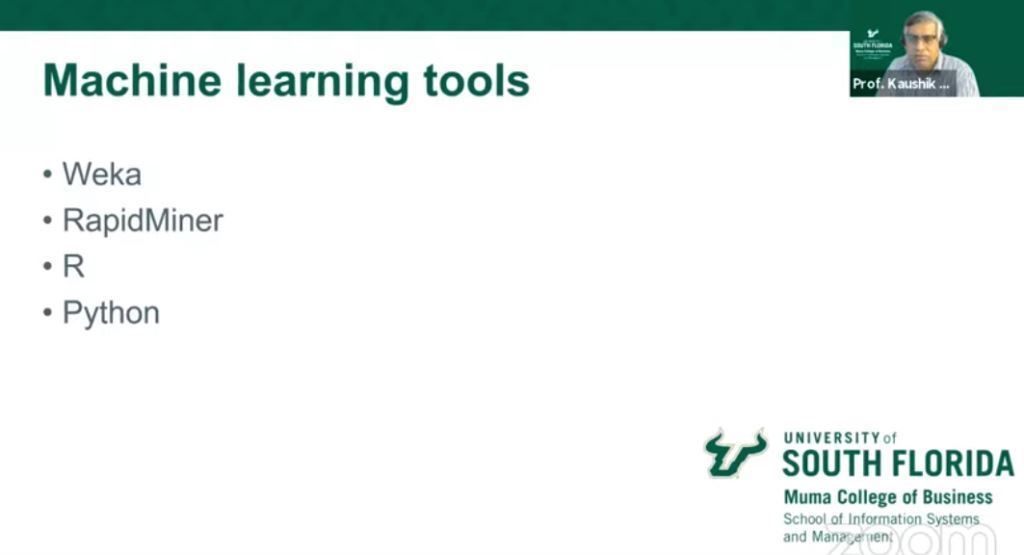
Continuing from the previous part, then Professor Dutta explained about various machine learning tools. Among them are Weka, Rapidminer, R, and Python. This time we will discuss about R. This tool is very unique because Professor Dutta's categorization is in the category of a statistical approach as well as a machine learning approach.
R (also known as GNU S) is a programming language and software for statistical and graphical analysis. R was created by Ross Ihaka and Robert Gentleman at the University of Auckland, New Zealand, and is now being developed by the R Development Core Team, of which Chambers is a member. R was named partly after the names of its two creators (Robert Gentleman and Ross Ihaka), and partly as a play on the name of S.
The R language is now the de facto standard among statisticians for statistical software development, and is widely used for statistical software development and data analysis.
R is part of the GNU project. The source code is freely available under the GNU General Public License, and precompiled binary versions are available for various operating systems. R uses a command line interface, although some graphical user interfaces are also available.
R provides various statistical techniques (linear and nonlinear modeling, classical statistical tests, time series analysis, classification, clustering, and so on) as well as graphs. R, like S, was designed as a true computer language, and allowed its users to add additional functionality by defining new functions. Another great strength of R is its graphing facility, which produces publication-quality graphics that can contain mathematical symbols. R has a LaTeX-like documentation format, which is used to provide comprehensive documentation, both online (in various formats) and in print.
Although R has a command line interface, there are several third-party graphical user interfaces, such as RStudio, an integrated development environment, and Jupyter, a notebook interface.
Advantages of R
R is a programming language that proves that quality software doesn't have to be expensive. The R language offers advanced data analysis capabilities. In fact, said Tech Target, it is free. This language is also quite "adult" because it already has many users and there are many communities that continue to develop it, making it easier for developers to find solutions to problems that may arise during its development.
The data visualization feature is also very sophisticated. The data visualization features are relatively high-quality and capable of producing beautiful graphics. This language has also been widely used in various leading scientific journal publications. So it can be said that this language is not just the language of data analysis activists because it is a hobby, but has been proven by various academic and professional business activities.
Tech giants such as Facebook, Google, and Microsoft are known to have used the R language. In addition, there are also other large companies such as Bing, Merck, TechCrunch, and Mozilla which are known to have used R in their statistical analysis.
Lack of R
This language is quite easy to learn. However, the convenience in question is not a language for beginners. Because the command-line display of this language is a little confusing. Well, as a solution, you can use an integrated development environment like RStudio.
Another drawback is that the data in R is stored in physical memory. This could be one of the drawbacks. If we work with R in the case of a lot of data, then we may run out of memory on the computer we are using. Even so, R already has integration with Hadoop as an alternative solution that is a framework for processing large data.
Another disadvantage of R is the execution alias reading R code also takes a long time. If you really want to speed things up, we have to work extra to optimize the code that is created.
Continued....
Learning Data-Driven Decisions for Managers in New Style Companies with Professor Dutta from USA Part 6.3
International Webinar
Back to News
International Webinar
Wednesday, November 2, 2022
Priyadi, S.Kom, M.Kom
0 Views