
The development of information technology today is very helpful in the company's business. However, if we do not understand the type of technology needed, we will choose the wrong technology. Especially in the field of decision-making for companies, there is one information technology product that is very helpful, namely a decision support system.
STEKOM university's efforts to have a global reach include holding webinars on an international scale. On this occasion we will discuss an international webinar held by STEKOM University in which one of the speakers is a professor from the United States. The resource person is Kaushik Dutta who is a Professor and School Director at the University of South Florida. Professor Dutta in his presentation delivered material on decision support systems which are IT products that are very useful in corporate business.
The material presented by Professor Dutta includes Framework, Applications for Business, Techniques, and Infrastructure. Because the material presented is quite long, the news article that discusses Professor Dutta's presentation is divided into several parts. We are currently entering part 7.1. If the reader wants to know the previous presentation, please see the previous sections in the title of the same article.
Continuing from the previous section, Professor Dutta then explains about the various databases that can be used in the development of machine learning. Professor Dutta divides the database category into two groupings in his discussion. These database groups are traditional databases that use relational concepts and modern databases that use non-relational/non-sql concepts.
Among the types of relational databases is MySQL. MySQL is an open-source SQL-based relational database management system (RDBMS) that works with a client-server model. While DBMS is a general database management system, RDBMS is database management software based on the relational model.
Most of the use of MySQL is for data warehousing (data warehouse), namely collecting data from various sources, for e-commerce, as well as logging applications. MySQL's first developer was MySQL AB, a Swedish company, which started its journey in 1994. The ownership rights of MySQL were then taken entirely by the US technology company, Sun Microsystems, when they bought MySQL AB in 2008.
In 2010, Oracle, which is one of the largest technology companies in the United States, acquired Sun Microsystems. Since then, MySQL is wholly owned by Oracle.
MySQL is one of the most popular brands of RDBMS software that implements a client-server model. Then, how do clients and servers communicate in the scope of the RDBMS?
So, both client and server, both use a domain-specific language – Structured Query Language (SQL). If you've seen or read some of the names combined with SQL, such as PostgreSQL and Microsoft SQL, then the server usually uses SQL syntax.
Although sometimes written in other programming languages, RDBMS software always uses SQL as the primary language for interacting with the database. MySQL itself is written in C and C++.
In the early 1970s, a computer scientist, Ted Codd, developed SQL with IBM's relational model. In 1974, SQL began to be widely used and quickly replaced the outdated languages, namely ISAM and VISAM.
The general description is like a WordPress password or code. You enter the password or code into the system to gain access to login to the dashboard. In this case, the SQL statement instructs the server to perform certain operations which can be described as follows:
- Data query: requesting specific information from an existing database.
- Data manipulation: add, delete, modify, sort, perform other operations to modify data, values, or visuals.
- Data identity: determines the data type, for example converting numeric data into integer data. In addition, it also determines the schema or relationship of each table in the database.
- Data access control: provides security methods to protect data, including determining who may view or use information stored in the database.
Oracle itself is actually also a database manufacturer that has the same name as the company name. Both use the concept of a relational database. But in oracle products, all the products are paid.
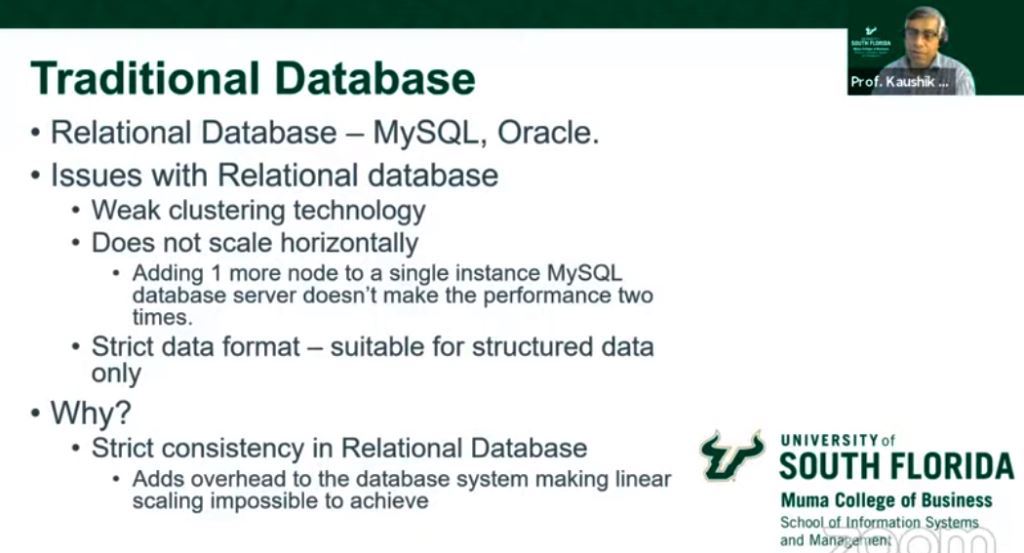
Professor dutta then discusses the problems with relational databases. One of them is its weak clustering technology. Relational databases also cannot scale horizontally, for example if adding 1 more node to one MySQL database server instance does not double performance. The strict data format in a relational database is also only suitable for structured data, while unstructured data will be difficult to manage with a relational database system.
Strict consistency in relational databases will mean that adding overhead to the database system makes linear scaling impossible to achieve. Whereas in real data conditions, often the data is not always the same structure. This will complicate various machine learning algorithms if the data is managed using a relational database.
Learning Data-Driven Decisions for Managers in New Style Companies with Professor Dutta from USA Part 7.1
International Webinar
Back to News
International Webinar
Thursday, November 3, 2022
Priyadi, S.Kom, M.Kom
0 Views