
The development of information technology today is very helpful in the company's business. However, if we do not understand the type of technology needed, we will choose the wrong technology. Especially in the field of decision-making for companies, there is one information technology product that is very helpful, namely a decision support system.
STEKOM university's efforts to have a global reach include holding webinars on an international scale. On this occasion we will discuss an international webinar held by STEKOM University in which one of the speakers is a professor from the United States. The resource person is Kaushik Dutta who is a Professor and School Director at the University of South Florida. Professor Dutta in his presentation delivered material on decision support systems which are IT products that are very useful in corporate business.
The material presented by Professor Dutta includes Framework, Applications for Business, Techniques, and Infrastructure. Because the material presented is quite long, the news article that discusses Professor Dutta's presentation is divided into several parts. We are currently entering part 7.2. If the reader wants to know the previous presentation, please see the previous sections in the title of the same article.
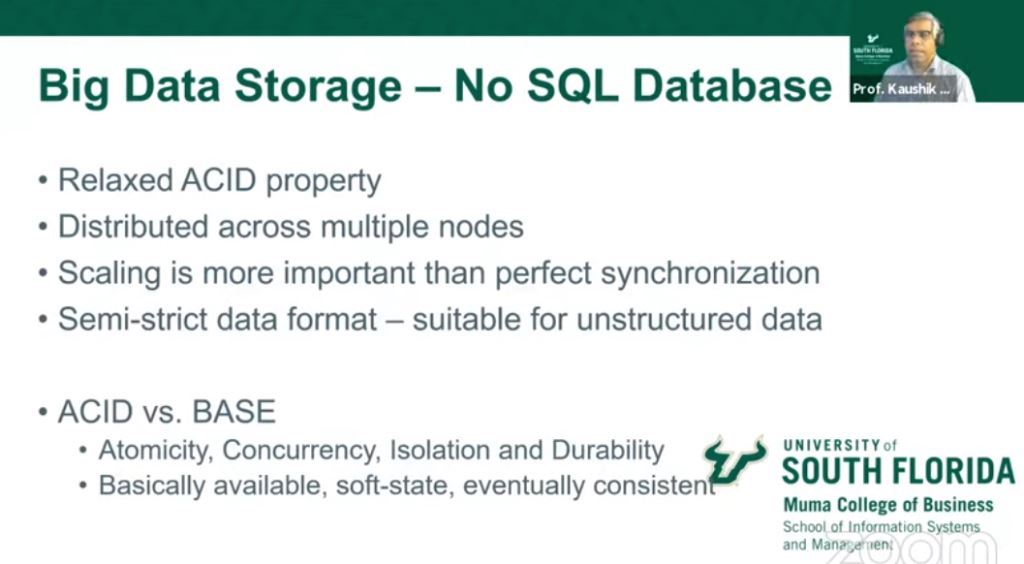
Continuing from the previous section, Professor Dutta then explains the various databases that can be used in the development of machine learning. Professor Dutta divides the database category into two groupings in his discussion. These database groups are traditional databases that use relational concepts and modern databases that use non-relational/non-sql concepts.
NoSQL databases are purpose-built for specific data models and have flexible schemas for building modern applications. NoSQL databases are widely recognized for their ease of development, functionality, and performance at scale.
NoSQL databases use a variety of data models to access and manage data. This type of database is optimized specifically for applications that require large data volumes, latency, and a flexible data model, which is achieved by reducing data consistency from other databases.
The following is an example of schema modeling for a simple book database that illustrates the differences between relational and non-relational data systems:
In relational databases, ledger records are often cloaked (or "normalized") and stored in separate tables, and relationships are defined by primary and foreign keys. In this example, the Books table has columns for ISBN, Book Title, and Edition Number, the Authors table has columns for AuthorID and Author Name, and the Author-ISBN table has AuthorID and ISBN columns. The relational model is designed to enable the database to link referentially between tables within the database, is normalized to reduce redundancy, and is generally optimized for storage.
In NoSQL databases, ledger records are usually stored as JSON documents. For each book, the item, ISBN, Book Title, Edition Number, Author Name, and Author ID are stored as attributes in a single document. In this model, the data is optimized for intuitive development and horizontal scalability.
NoSQL databases are perfect for use with modern applications such as mobile, web and game applications that require a flexible, scalable, high-functionality database to provide a good user experience.
- Flexibility: NoSQL databases generally provide flexible schemas that allow for faster and more iterative development. The flexible data model makes NoSQL databases ideal for semi-structured and unstructured data.
- Scalability: NoSQL databases are generally designed to scale by using distributed hardware clusters instead of scaling up by adding expensive and powerful servers. Some service providers handle the cloud activity behind this operation as a fully managed service.
- High performance: NoSQL databases are optimized for specific data models and access patterns which provide higher performance than if you were trying to get similar functionality to a relational database.
- High functionality: NoSQL databases provide custom built APIs and functional data types for each appropriate data model.
Classification of database types in non-relational database systems is different from relational databases. Here are the details:
- Key-value: Key-value databases can be partitioned and allow horizontal expansion at a scale that other database types cannot achieve. Use cases such as gaming, ad technology, and IoT are quite good at using key-value data models. Amazon DynamoDB is designed to provide single-digit millisecond latency for any workload scale. This consistent performance is a big reason the Snapchat Stories feature, which includes Snapchat's largest write-to-storage workload, was moved to DynamoDB.
- Documents: In application code, data is often represented as an object or document like JSON because it is an efficient and intuitive data model for developers. Document databases make it easy for developers to store and query data in databases using the same document model formats that they use in application code. The flexible, semistructured and hierarchical nature of documents and document databases allows documents and document databases to evolve according to application requirements. The document model works well with catalogs, user profiles, and content management systems where each document is unique and evolves over time. Amazon DocumentDB (with MongoDB compatibility) and MongoDB are popular document databases that provide powerful and intuitive APIs for flexible and iterative development.
- Graphics: The graphical database aims to make it easier to build and run applications running on always-connected datasets. Common use cases for graph databases include social media networks, recommendation engines, fraud detection, and knowledge graphs. Amazon Neptune is a fully managed graph database service. Neptune supports the Property Graph and Resource Description Framework (RDF) models, providing a choice of two graph APIs: TinkerPop and RDF/SPARQL. Popular chart databases include Neo4j and Giraph.
- In memory: Gaming and ad technology applications have use cases such as leaderboards, session storage and real-time analytics that require millisecond response times and can have large traffic peaks at any time. Amazon MemoryDB for Redis is a durable, Redis-compatible in-memory database service that provides microsecond read latency, single-digit millisecond write latency, and Multi-AZ resilience. MemoryDB is purpose-built to provide blazing fast performance and durability so you can use it as the primary database for modern microservices applications. Amazon ElastiCache is a fully managed in-memory cache storage service compatible with Redis and Memcached, to serve low-latency, high-throughput workloads. Customers like Tinder, who require real-time response from their applications, rely on in-memory data storage rather than disk-based data storage. Amazon DynamoDB Accelerator (DAX) is another example of a custom-built data store. DAX makes DynamoDB read orders of magnitude faster.
- Search: Some application outputs are logged to help developers to solve problems. Amazon OpenSearch Service is specifically built to provide near-real-time visualization and analytics of machine-generated data by indexing, collecting, and searching semi-structured logs and metrics. Amazon OpenSearch Service is also a powerful, high-performance search engine for full-text search use cases. Expedia uses more than 150 Amazon OpenSearch Service domains, 30 TB of data, and 30 billion documents for mission-critical use cases, from operational monitoring and troubleshooting to distributed application stack tracking and price optimization.
For decades, the main data model used for application development has been the relational data model used by relational databases such as Oracle, DB2, SQL Server, MySQL, and PostgreSQL. It was not until the mid to late 2000s that other data models began to gain significant adoption and use. To distinguish and categorize these new database classes and data models, the term “NoSQL” was coined. Often the term "NoSQL" is used interchangeably with "nonrelational."
Learning Data-Driven Decisions for Managers in New Style Companies with Professor Dutta from USA Part 7.2
International Webinar
Back to News
International Webinar
Thursday, November 3, 2022
Priyadi, S.Kom, M.Kom
0 Views