
The development of information technology today is very helpful in the company's business. However, if we do not understand the type of technology needed, we will choose the wrong technology. Especially in the field of decision making for companies, there is one information technology product that is very helpful, namely a decision support system.
STEKOM university's efforts to have a global reach include holding webinars on an international scale. On this occasion we will discuss an international webinar held by STEKOM University in which one of the speakers is a professor from the United States. The resource person is Kaushik Dutta who is a Professor and School Director at the University of South Florida. Professor Dutta in his presentation delivered material on decision support systems which are IT products that are very useful in corporate business.
The material presented by Professor Dutta includes Framework, Applications for Business, Techniques, and Infrastructure. Because the material presented is quite long, the news article that discusses Professor Dutta's presentation is divided into several parts. We are currently entering the 8th section. If the reader wants to know the previous presentation, please see the previous sections in the title of the same article.
Continuing from the previous section, this time we discuss the material presented by Mr. Mampuono. Mr. Mampuono, who is one of the leaders of the professional teacher organization, discussed the career challenges in the world of work in today's conditions.
Mr. Mampuono at the beginning of his explanation regarding the current condition said that the growth of the workforce has grown more than expected. This will displace 85 million jobs in the next five years. Automation, in tandem with the COVID-19 recession, creates a “double distraction” scenario for workers. The adoption of technology by enterprises will change tasks, jobs and skills by 2025.
Survey: 43 percent of businesses are set to reduce their workforce due to technology integration, 41 percent plan to expand use of contractors for task-specific work, and 34 percent plan to expand their workforce as a result of technology integration. Five years from now, employers will divide work between humans and machines roughly.
As the economy and job market evolve, new roles will emerge across the nursing economy in technology (such as artificial intelligence—AI) and in content creation careers (such as social media management and content writing). Emerging professions reflect greater demand for green economy jobs; a role at the forefront of AI data and economics; and new roles in engineering, cloud computing, and product development. Upcoming work highlights the importance of sustained human interaction in the new economy through a role in the care economy; in marketing, sales and content production; and in roles that depend on the ability to work with different types of people from different backgrounds.
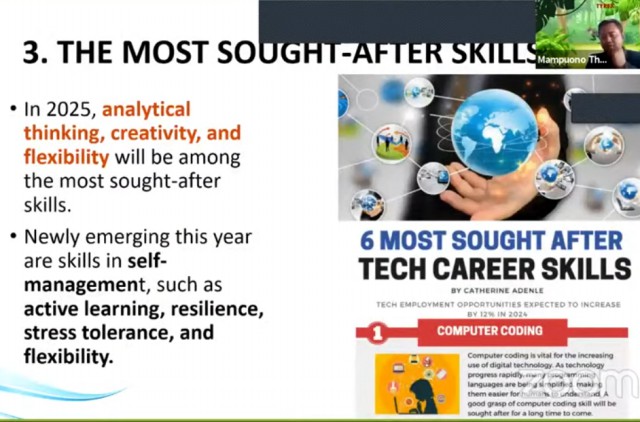
In the future, the map of workforce competency needs will experience a number of shifts. By 2025, analytical thinking, creativity and flexibility will be among the most sought-after skills. The areas of expertise that have emerged this year are skills in self-management, such as active learning, resilience, stress tolerance, and flexibility.
The most competitive businesses will focus on improving the skills of their workers. For workers who will remain in their roles for the next five years, nearly half will require retraining of their core skills. The public sector needs to provide stronger support for retraining and skills upgrading for workers at risk or for displaced workers. Currently, 21 percent of businesses report being able to use public funds to support their employees through retraining initiatives. The public sector must provide incentives for investment in future markets and jobs, offer stronger safety nets for displaced workers during job transitions, and address long-delayed improvements to the education and training system.
Remote work will also be more and more present in the future. About 84 percent of employers are ready to quickly digitize work processes, including a significant expansion of remote work. Employers say there is potential to move 44 percent of their workforce to operate remotely. However, 78 percent of business leaders expect some negative impact on worker productivity, and many businesses are taking steps to help their employees adapt.
Next, Mr. Mampuono conveyed about career strategies that should be carried out by students. The following is a list of suggestions given by him:
- Become a true lifelong and literate learner (Language, numeric, digital, science, finance, culture and diversity).
- Become a good decision maker in choosing a future career that best suits his interests and talents.
- Prepare to face the new era with the required skills (hard skills, soft skills and after skills).
- Improves analytical thinking, creativity and flexibility which will be one of the most sought after skills.
- Improve skills in self-management, such as active learning, resilience, stress tolerance, and flexibility.
Not only students were given advice by Mr. Mampuono, but he also gave suggestions for strategies that could be done by the teacher:
- Become a true lifelong learner.
- Prepare for the new era with the skills needed.
- Global Gurupreneurship.
- Good model in hard skills, soft skills and after skills.
- Develop an Adaptive Solution program in collaboration with companies and industries in a “strong and lasting marriage”.
Learning Data-Driven Decisions for Managers in New Style Companies with Professor Dutta from USA Part 8
International Webinar
Back to News
International Webinar
Thursday, November 3, 2022
Priyadi, S.Kom, M.Kom
0 Views