
The large number of participants in the international webinar that was attended by STEKOM University and various participants from various universities around the world required the event to be continued on the next day. On the second day of the event, the Chancellor of STEKOM University gave another speech before the event started. In his speech, the Chancellor of STEKOM University gave his best appreciation to all parties who supported the implementation of the international webinar. The Chancellor of STEKOM University also expressed his gratitude to all the speakers who will deliver the next presentation on the second day.
The cultural and culinary presentations recommended to foreign tourists on the second day were started by a presenter from Indonesia who was delivered by Wibi Ardi Alvianto who is also a lecturer at STEKOM University. In her presentation, wibi said that Indonesia's rich culture gave birth to so many inspiring works of art such as paintings, sculptures, music, dance, theater, and many more. From ancient times to contemporary times, Indonesian Artists continue to draw inspiration from the culture, values, and nature of the archipelago, to ensure that art lives and thrives.
In the next presentation, Wibi explained about traditional musical instruments in Indonesia. In his explanation, wibi said that because it is a country with many different tribes and ethnic groups, Indonesian music itself is also very diverse, coming in hundreds of different forms and styles. Each region has its own culture and art, so traditional music from region to region also has a uniqueness that is different from one another. For example, each traditional music is often accompanied by their own dance and theater. The world of contemporary music is also shaped by various foreign influences, such as America, Britain, Japan, Korea, and India.
The music of Java, Sumatra, Bali, Flores (the Lesser Sunda Islands) and other islands is well documented and recorded, and further research by Indonesian and international scholars is also underway. Music in Indonesia precedes historical records, various indigenous Indonesian tribes often include songs and songs accompanied by musical instruments in their rituals. Indonesian contemporary music is currently also popular among neighboring countries, such as Malaysia, Singapore and Brunei.
In general, traditional Indonesian music and songs combine strong beats and harmonies with strong influences from Indian and Malay classical music. His influence is very visible in the popular traditional music genre Dangdut.
The identity of Indonesian music as we know it today began when the Bronze Age culture migrated to the archipelago in the 2-3rd century BC. Indonesian traditional music often uses percussion instruments, especially gongs and drums. Some of them developed elaborate and distinctive musical instruments, such as the Rote island sasando stringed instrument, the Sundanese angklung, and the complex and sophisticated Javanese and Balinese gamelan orchestra.
Indonesia is the home of gong chime, gong chime is a general term for a set of small, high pitched pot gongs. Gongs are usually placed in order of note, with the boss up on a string held in a low wooden frame. The frame may be rectangular or circular (the latter is sometimes called a "gong circle"), and may have one or two rows of gongs. They are played by one to four musicians, each using two soft sticks to hit them. They are important instruments in many Indonesian musical ensembles, such as gamelan, kulintang, and talempong.
In the next explanation, Wibi said that traditional music must be preserved. Traditional music must continue to grow and develop in the community that gave birth to it, because it will become a cultural heritage for these community groups. Traditional music is a national identity that must be developed and preserved. Among the preservation of traditional music is adapting and collaborating with the latest trends and technologies.
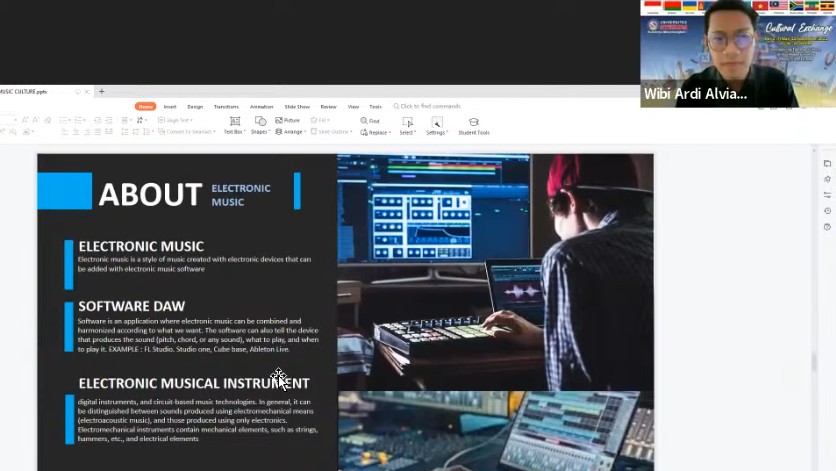
Furthermore, Wibi explained that he also participated in preserving traditional music with today's technology, namely by using electronic musical instruments. Where electronic music is music that uses electronic musical instruments, digital instruments, and circuit-based music technology. In general, it can be distinguished between sounds produced using electromechanical means (electroacoustic music), and those produced using only electronics. Electromechanical instruments contain mechanical elements, such as strings, hammers, etc., and electrical elements, such as magnetic pickups, power amplifiers and loudspeakers. Examples of electromechanical sound-producing devices include the telharmonium, hammond organs, and electric guitars, which are usually made loud enough for the performer and audience to hear with an instrument amplifier and speaker cabinet. Pure electronic instruments do not have vibrating strings, hammers, or other sound-producing mechanisms. Devices such as theremins, synthesizers, and computers can produce electronic sounds.
The collaboration between electronic music and traditional music, in Wibi's explanation, will produce Ethnic fusion. Ethnic Fusion is not the same as world fusion (a synthesis of jazz and world music) or worldbeat (which can be taken from a number of world music, often adding Western pop influences). In contrast, ethnic fusion is generally rooted in the sound and philosophy of new-age music, seeking to incorporate traditional ethnic folk music into contemporary electronic music. Often, though not always, the goal is to find a way to create unity and harmony between Western technology and a more earth- and nature-oriented culture. In time, ethnic fusion became a favorite way for adventurous contemporary instrumental musicians to expand their sound with new rhythms or non-Western instrumentation; others come naturally to certain ethnic music and combine it with a contemporary new-age/instrumental sensibility.
The cultural and culinary presentations recommended to foreign tourists on the second day were started by a presenter from Indonesia who was delivered by Wibi Ardi Alvianto who is also a lecturer at STEKOM University. In her presentation, wibi said that Indonesia's rich culture gave birth to so many inspiring works of art such as paintings, sculptures, music, dance, theater, and many more. From ancient times to contemporary times, Indonesian Artists continue to draw inspiration from the culture, values, and nature of the archipelago, to ensure that art lives and thrives.
In the next presentation, Wibi explained about traditional musical instruments in Indonesia. In his explanation, wibi said that because it is a country with many different tribes and ethnic groups, Indonesian music itself is also very diverse, coming in hundreds of different forms and styles. Each region has its own culture and art, so traditional music from region to region also has a uniqueness that is different from one another. For example, each traditional music is often accompanied by their own dance and theater. The world of contemporary music is also shaped by various foreign influences, such as America, Britain, Japan, Korea, and India.
The music of Java, Sumatra, Bali, Flores (the Lesser Sunda Islands) and other islands is well documented and recorded, and further research by Indonesian and international scholars is also underway. Music in Indonesia precedes historical records, various indigenous Indonesian tribes often include songs and songs accompanied by musical instruments in their rituals. Indonesian contemporary music is currently also popular among neighboring countries, such as Malaysia, Singapore and Brunei.
In general, traditional Indonesian music and songs combine strong beats and harmonies with strong influences from Indian and Malay classical music. His influence is very visible in the popular traditional music genre Dangdut.
The identity of Indonesian music as we know it today began when the Bronze Age culture migrated to the archipelago in the 2-3rd century BC. Indonesian traditional music often uses percussion instruments, especially gongs and drums. Some of them developed elaborate and distinctive musical instruments, such as the Rote island sasando stringed instrument, the Sundanese angklung, and the complex and sophisticated Javanese and Balinese gamelan orchestra.
Indonesia is the home of gong chime, gong chime is a general term for a set of small, high pitched pot gongs. Gongs are usually placed in order of note, with the boss up on a string held in a low wooden frame. The frame may be rectangular or circular (the latter is sometimes called a "gong circle"), and may have one or two rows of gongs. They are played by one to four musicians, each using two soft sticks to hit them. They are important instruments in many Indonesian musical ensembles, such as gamelan, kulintang, and talempong.
In the next explanation, Wibi said that traditional music must be preserved. Traditional music must continue to grow and develop in the community that gave birth to it, because it will become a cultural heritage for these community groups. Traditional music is a national identity that must be developed and preserved. Among the preservation of traditional music is adapting and collaborating with the latest trends and technologies.
Furthermore, Wibi explained that he also participated in preserving traditional music with today's technology, namely by using electronic musical instruments. Where electronic music is music that uses electronic musical instruments, digital instruments, and circuit-based music technology. In general, it can be distinguished between sounds produced using electromechanical means (electroacoustic music), and those produced using only electronics. Electromechanical instruments contain mechanical elements, such as strings, hammers, etc., and electrical elements, such as magnetic pickups, power amplifiers and loudspeakers. Examples of electromechanical sound-producing devices include the telharmonium, hammond organs, and electric guitars, which are usually made loud enough for the performer and audience to hear with an instrument amplifier and speaker cabinet. Pure electronic instruments do not have vibrating strings, hammers, or other sound-producing mechanisms. Devices such as theremins, synthesizers, and computers can produce electronic sounds.
The collaboration between electronic music and traditional music, in Wibi's explanation, will produce Ethnic fusion. Ethnic Fusion is not the same as world fusion (a synthesis of jazz and world music) or worldbeat (which can be taken from a number of world music, often adding Western pop influences). In contrast, ethnic fusion is generally rooted in the sound and philosophy of new-age music, seeking to incorporate traditional ethnic folk music into contemporary electronic music. Often, though not always, the goal is to find a way to create unity and harmony between Western technology and a more earth- and nature-oriented culture. In time, ethnic fusion became a favorite way for adventurous contemporary instrumental musicians to expand their sound with new rhythms or non-Western instrumentation; others come naturally to certain ethnic music and combine it with a contemporary new-age/instrumental sensibility.