
The many diversity of traditions that exist in Indonesia to be
recommended to tourists as a reason to provide representatives from
other Indonesia to explain more about other Indonesian traditions and
cultures. This time the explanation was given by Joseflim who is also
a student of STEKOM University majoring in informatics engineering.
Slightly different from the previous presenters, Joseflim's
explanation of Indonesia is more about pop culture and its comparison
with traditional culture.
The first explanation
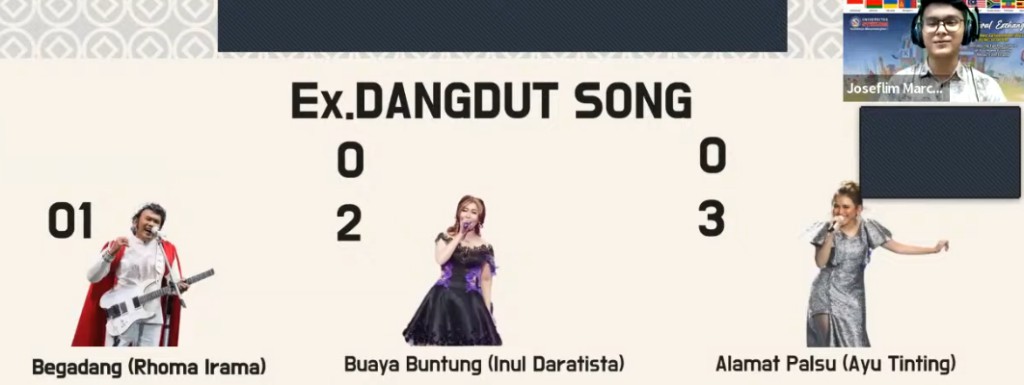
about Indonesian music from Joseflim whose leadership is very
interesting is about dangdut music. Dangdut is one of the traditional
Indonesian popular music genres which in particular has elements of
Hindustani (North Indian), Malay, and Arabic music. Dangdut is
characterized by the booming of tabla (Indian percussion instrument)
and drums. Dangdut is also heavily influenced by traditional Indian
and Bollywood music songs.
Initially dangdut music
was known as the "Malay orchestra". Then, dangdut was
influenced by Indian music through the Bollywood film performed by
Ellya Khadam with the song "Indian Doll", thus appearing as
Dangdut in 1968 with the main character Rhoma Irama. In the evolution
towards contemporary musical forms, there are now influences from
Indian musical elements (mainly from the use of tabla) and Arabic (on
twists and harmonization). Changes in Indonesian political currents
in the late 1960s opened up the influx of strong western music
influences with the inclusion of the use of electric guitars as well
as forms of marketing. Since the 1970s dangdut can be said to have
matured in a contemporary form. As popular music, dangdut is very
open to the influence of other forms of music, ranging from
keroncong, style, gamelan, gambus, rock, reggae, pop, and even
electronic dance music (house, etc.). "Spiritual dangdut"
can be considered as a special lyrical direction (for example, the
album Haji by Rhoma Irama).
Indian influence is also very
strong in this dangdut music genre, but from the style of harmony and
instruments, it is also popularized with classical Indian-themed
dangdut songs sung by popular dangdut singers such as Rhoma Irama
with his song titled Terajana, Mansyur S. his song, Khana, Ellya
Khadam with the song Indian Doll and Via Vallen with a song called
Sayang, made dangdut music even more popular today.
Dangdut
has actually become folk music in Indonesia and surpassed other
genres of music in popularity: people like to sing their songs with
karaoke, both for themselves and during family events, employees in
central government offices do gymnastics with the music before start
work, and so on. Besides Indonesia, dangdut which is quite popular
also in Malaysia, there are a number of names of dangdut from
Indonesia.
Next, Joseflim explained about Indonesian
pop music. What is meant by Indonesian pop music is broadly defined
as a genre of pop music that exists in Indonesia, but in a broader
sense it can also include Indonesian pop culture which also includes
Indonesian films and soap operas. Indonesian pop music develops very
unique and varied, both influenced by international culture,
especially from western music culture, as well as those influenced by
traditional music culture.
Next, Joseflim explained
about the very varied folk songs in Indonesia. Regional songs are
music that has been in the community for generations and is
maintained as a means of entertainment or religious activities. The
role of the regional anthem is similar to the national anthem, but
its status is only regional and is written as an anthem of a region.
Regional songs usually have lyrics according to their respective
regional languages, such as tondok kadadingku from South Sulawesi and
Rasa Sayange from Maluku.
This folk song or regional
music usually appears and is sung or played in certain traditions in
each region, for example when lulling children, children's games,
folk entertainment, folk parties, people's struggles, and so on. .
Regional songs usually refer to a song that has a special rhythm for
a region. There are folk songs that have become popular throughout
the country as a result of radio and television broadcasts.
Next,
Joseflim explained about keroncong music. Keroncong is a type of
Indonesian music that uses strings, flutes, and vocals. The root of
keroncong comes from a type of Portuguese music known as fado which
was introduced by the sailors and slaves of the nation's merchant
ships since the 16th century to the archipelago. From mainland India
(Goa) this music was first entered in Malacca and then played by
slaves from the Moluccas. Weakening of the influence of Portugis in
the 17th century in the archipelago does not necessarily mean the
loss of this music. An early form of this music was called moresco (a
dance originating in Spain, such as the slightly slower rhythmic
polka), in which one of Kusbini's recast songs is now known as Kr.
Muritsku, accompanied by stringed instruments. The keroncong music
originating from the monument is called the keroncong Tugu. In its
development, a number of traditional elements of the archipelago,
such as the use of flutes and some gamelan components, have been
introduced. Around the 19th century this mixed form of music was
already popular in many places in the archipelago, even to the Malay
Peninsula. This golden age continued until around the 1960s, and then
faded due to the entry of a wave of popular music (rock music that
developed since 1950, and the success of the Beatles music group and
the like since 1961 until now). Nevertheless, keroncong music is
still played and enjoyed by various levels of society in Indonesia
and Malaysia until now.
Joseflim's explanation
continued about kasidah music. Kasidah (qasidah, qasida) is a form of
Arabic literary epic poetry that is sung. Kasidah is a sound art that
breathes Islam with its songs containing many elements of Islamic
da'wah and good advice according to Islamic teachings.
Second Day of STEKOM University Cultural Exchange Part 1.2 (Indonesian Tradition by Joseflim)
International Webinar
Back to News
International Webinar
Sunday, October 23, 2022
Priyadi, S.Kom, M.Kom
0 Views