
The international webinar “culture exchange” held by STEKOM
University on the second day continues. Speakers from various
universities around the world take turns giving interesting
explanations about the traditions or cuisine of their respective
countries. No less interesting speakers are those from Mongolia. The
speaker from Mongolia is Tuvshintulga.Kh who is a student from
Mandakh University from Mongolia.
Mongolia was the
center of the Mongol Empire in the 13th century but was ruled by the
Qing Dynasty from the late 17th century until an independent
government was formed with the help of the Soviet Union in 1921.
However, Mongolia's independence was not recognized by China until
1949. After the communists took control of mainland China , China
finally recognized Mongolia's independence. After the collapse of the
Soviet Union, Mongolia embraced democracy. With an area comparable to
Alaska, most of Mongolia has arid lands, mostly grasslands with
mountains to the west and north and the Gobi Desert to the south. The
majority of the population is ethnically Mongol who adheres to
Tibetan Buddhism with a nomadic life.
At 1,564,116
km2 (603,909 sq mi), Mongolia is the 19th largest country in the
world (after Iran and before Peru). The geography of this country is
the Gobi Desert in the south and the cold mountainous region in the
north. Much of Mongolia is also made up of steppes. The highest point
in Mongolia is Khüiten Hill in Tavan bogd at 4,374 m (14,350 ft).
Most parts of the country feel hot in summer and very cold in winter
(in January the average temperature is −30 °C (−22 °F)).
Ulaanbaatar, the capital of the country, is the capital of the
country with the lowest average temperature in the world.
Various
forms of Shamanism have been widely practiced throughout Mongolian
history today, as such beliefs were common among nomadic peoples in
Asian history. Such beliefs gradually culminated in Tibetan Buddhism,
but shamanism has left its mark on Mongolian religious culture, and
is still practiced.
Traditionally, Tibetan Buddhism
has been the dominant religion. However, it was suppressed under the
communist regime until 1990, with only one monastery allowed to stay.
Since 1990, when liberalization began, Buddhism has experienced a
renaissance.
At the beginning of the presentation, a
speaker from Mongolia explained about a historical Mongolian film
entitled 'Mandukhai Setsen Khatan-Queen Mandukhai the Wise'.
Mandukhai Khatun, also known as Mandukhai Sechen Khatun, was a Khatun
(queen) of Northern Yuan. With her second husband Batmunkh Dayan
Khan, she helped reunite the warring Mongols.
Mandukhai
succeeded in keeping Dayan Khan in power as a descendant of Genghis
Khan, and he defeated Oirat. Both achievements have contributed to
the legend that has formed about his life. He left behind seven sons
and three daughters. All subsequent Mongol khans and aristocrats were
his descendants, including Altan Khan and Ligden Khan.
The film's
music was composed by Jantsannorov Natsag who is one of Mongolia's
most famous composers and musicologists. Mandukhai's life is also
fixed in the historical fiction Fractured Empire Saga, by Starr Z.
Davies, published 2021-2022, a series of four books: Daughter of the
Yellow Dragon, Lords of the Black Banner, Mother of the Blue Wolf,
Empress of the Jade Realm.
Mandukhai is
also the main protagonist of the historical novel Mandukhai, written
by German writer Tanja Kinkel in 2014. The novel tells of his life,
and how he became the Khatun of his people.
Next,
the speaker talked about traditional Mongolian music. According to
the speakers, their culture is very unique and has a long story
unlike anything you can find in Asia. The same goes for music. Song
songs, long songs and morin khuurs are symbols of Mongolia.
The
speaker explained the traditional Mongolian music, which is the
singing of top notes like the singing style that is unique in Central
Asian countries. This type of singing involves simultaneously
producing two different notes, one similar to a regular whistle,
while the other is a drone bass.
The next
explanation is about the long chant. This is the main format of
Mongolian music, and also unique in our country. You can easily
distinguish it from other song formats by the fact that each syllable
of the text is extended, which is why even a short five or four
minute song may only have 12 or a few words. And, There is no fixed
rhythm, but there are wide intervals and a slow tempo. The theme of
the text can be anything, but is usually philosophical, romantic, or
religious.
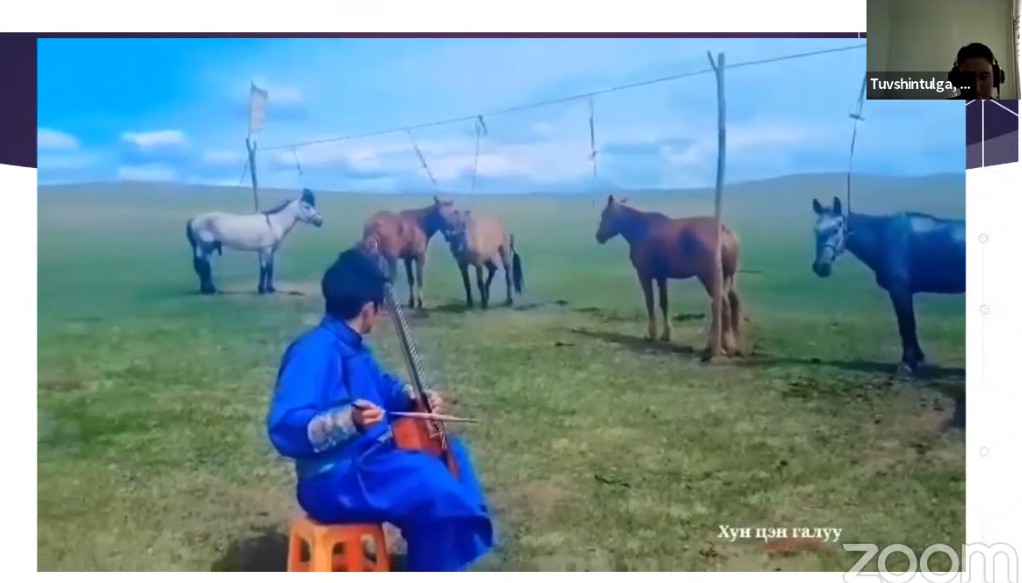
The next music described is morin khuur
(horse-head fidle). Morin Khuur is a horse-headed violin. Morin khuur
is still a unique stringed instrument consisting of a violin-shaped
body and two strings. This instrument has a horse engraved on its peg
box, which is why tradition has it that the device exists to
represent the movements and sounds of horses. This is the most famous
Mongolian instrument.