
When watching science fiction films, there are cars that can move on
their own without a driver, reminders with a human voice, to cooling
machines that can provide information about items that are running
low on stock. Now, with technology that is often called IoT, all of
these things can be realized and we can enjoy the benefits in
everyday life. In accordance with the international webinar held by
the University of Computer Science and Technology (STEKOM University)
on May 28, 2021 with the theme IoT and Cyber Security in the
Industry.
STEKOM University invited Dr. Abur Mustikawanto,
M.Ed, Ableono, M. Kom, Dr. George Anwar, Ph.D., Prof. Moitrayee
Chatterjee, Ph.D and Prof. Hung Shang Chao, Ph.D to provide material
exposure about IoT and cyber security. The event was opened by the
Chancellor of STEKOM University, Dr. Joseph Teguh Santoso.
IoT
stands for Internet of Things which is an extension of technology
that is utilized to the fullest to help simplify daily work. The
industrial revolution 4.0 encourages the birth of new technologies
and is connected to the internet. This raises a link with cyber
security, which should be known to the public because the largest IoT
users will be the wider community apart from industry and
offices.
IoT is a technology that allows an object to be
able to send data over a connection without the help of computers and
humans. If you look at its history, the term IoT was first referred
to by British technology expert Kevin Ashton, who he described this
technology as the "eyes" and "ears" of
computers.
Interestingly, long before Kevin coined the
term IoT, Massachusetts Institute of Technology graduate technologist
John Romkey created the world's first IoT smart device in 1990. The
IoT device is Romkey's computer-controlled toaster.
Technically,
IoT has a number of supporting technology components that allow it to
work optimally. Anything?
1. Sensor
Sensors are
able to change IoT devices, precisely in terms of networks, from
passive systems to active and integrated with the surrounding
environment.
2. Artificial Intelligence
Artificial
intelligence (AI) is one of the common threads that "turn on"
IoT. With AI, devices can communicate intelligently. Moreover,
AI-enabled IoT devices will be able to perform more complex
analytical capabilities, such as collecting data, managing networks,
and even developing algorithms. Thus, the presence of AI on IoT
devices also allows them to carry out their own activities without
having to receive instructions from the user.
3. Network
Connection
The network connection is also a supporting
component of the IoT system to be able to communicate smoothly. The
connectivity required should actually run stable, but it doesn't need
to be present in large loads.
4. Micro Device
The
presence of micro or small devices can increase the accuracy,
scalability and flexibility of IoT performance. Not to mention, the
smaller the device will also have less cost value.
How IoT
works
IoT works by utilizing programming instructions
whose every command can generate interaction between other connected
devices automatically without user intervention, even remotely. The
vital factor that makes IoT devices smooth is the internet network
which is the connector between the system and the device. Meanwhile,
humans in this stage only become monitors for each device's behavior
while they are working.
This webinar can be a good first
step for IoT users, so that users understand the importance of data
or network security, because the latest technology is mostly
connected to the internet, said the Chancellor when opening this
webinar. The event was successful because many participants who
attended also interacted with the speakers.
The next topic
that is also discussed in this international webinar is
cybersecurity. Cybersecurity is an effort made to protect computer
systems from various threats or illegal access. Cyber security
includes the tools, policies, and security concepts that can be used
to protect the assets of organizations and users. Cyber security can
minimize the entry of threats into computer systems. These safeguards
apply to computing devices, applications, services, and information
that is transmitted and stored in the cyber
environment.
Cybersecurity refers to the practice of
ensuring three important points called the CIA Triad. The three
points are confidentiality, integrity, and availability, as stated by
Warkentin & Orgeron in the book Teaching Based on Digital
Technology by Sandirana Juliana Nendissa. CIA Triad is a security
mode developed to help humans understand various information
technology security and become the main concept of cyber security.
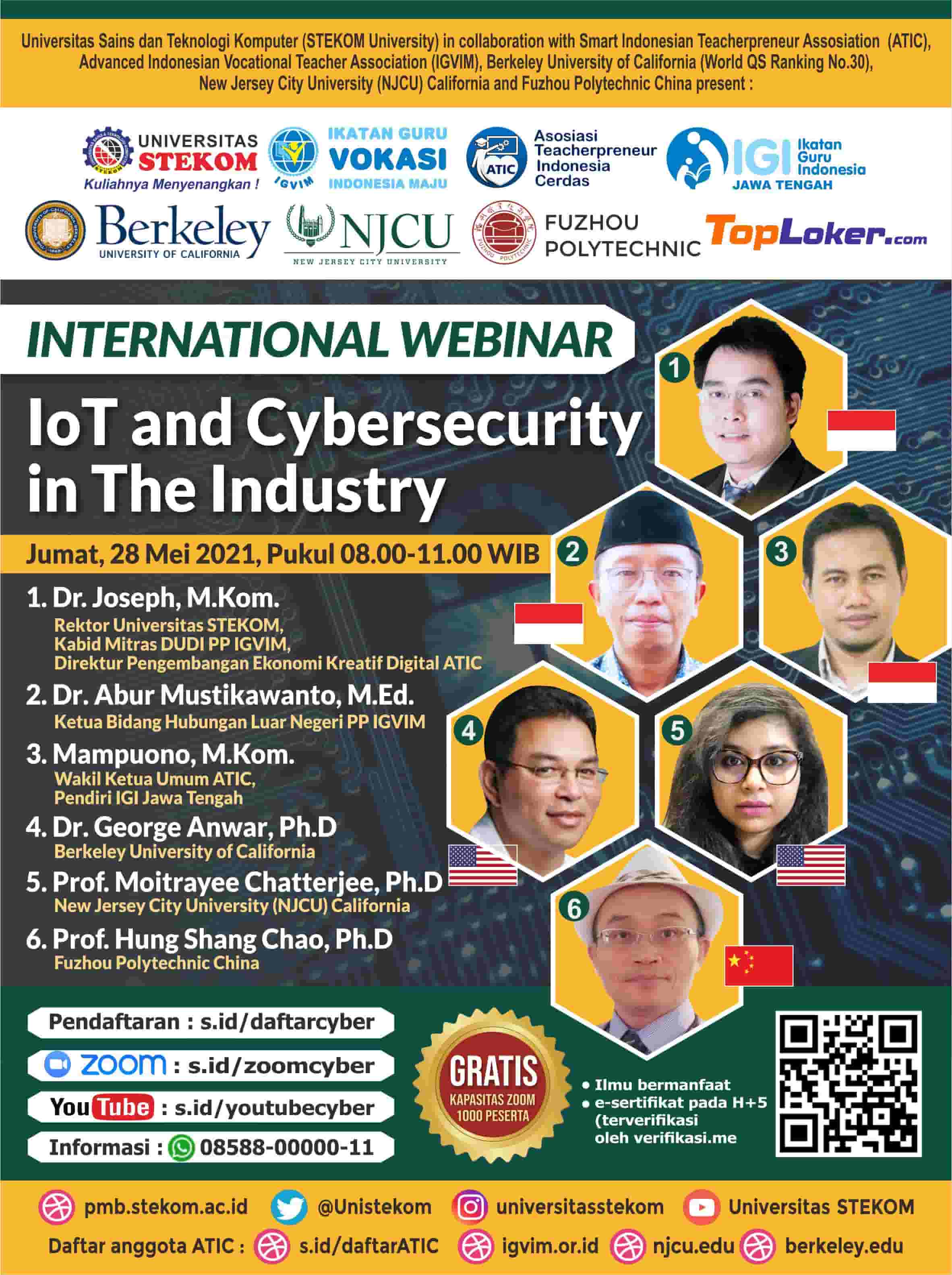
STEKOM International Webinar on IoT and cybersecurity together with two Universities from the United States and one University from China
International Webinar
Back to News
International Webinar
Tuesday, October 11, 2022
Priyadi, S.Kom, M.Kom
0 Views