
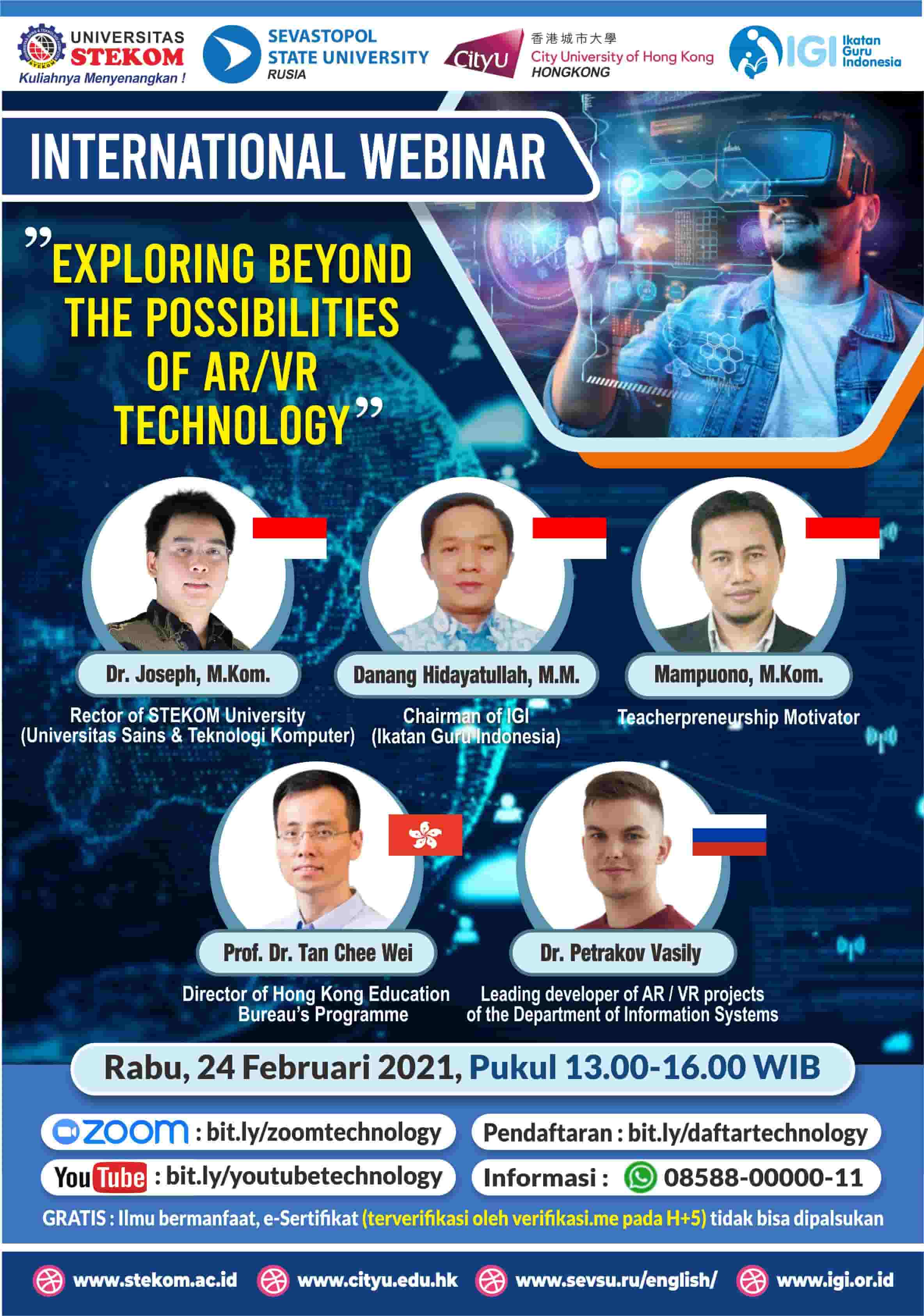
On February 24, 2021, the University of Computer Science and
Technology in collaboration with the Education Bureau in Hong Kong,
Russian AR and VR Developers and IGI held an international webinar to
talk about the future role of AR and VR.
VR and AR
technology have become familiar to the community, especially for
gamers. The world of education has also started using this technology
to maximize the educational process. AR (Augmented Reality) is
briefly used to provide life view elements that we usually get from
our smartphones. While VR (Virtual Reality) offers the world through
digital.
Understand more about Augmented
Reality
Augmented reality is a technology that combines
virtual objects in the form of two dimensions and can also be three
dimensions into a real environment and then projects them as reality
in real time. Later this reality can be applied to all senses,
including hearing, smell and touch.
This technology is
widely used in areas of human life, in addition to such as health,
military, manufacturing industry and education. AR technology is also
used to insert certain information into the virtual world, then
display it to the real world through the help of additional
equipment, such as webcams, computers, cellphones, androids to
glasses.
Another definition that explains what augmented
reality is is a technology that allows real-time integration of
digital content created by computers with the real world. This
technology allows users to view 2D or 3D virtual objects projected
from the real world.
This technology is growing, which was
initially applied to PCs and in the 1990s even applied to mobile
devices. Mobile devices are considered to support the development of
this technology, it cannot be separated from the hardware and
software components needed to develop the technology.
How
augmented reality works
In accordance with the
understanding above that AR technology can be displayed in various
mobile devices. In the process, the mobile device will act as an
output device, which can display information in the form of videos,
images, animations and 3D models. Later, users will see the results
in the form of artificial and natural light.
The way this
technology works is using SLAM or Simultaneous Localization and
Mapping, sensors and depth gauges. As for measuring sensor data which
serves as a tool to determine a location and calculate the distance
from the previous location to the destination location. And this
process cannot be separated from other supporting components, such as
the following.
• Cameras and Sensors
Cameras
and sensors are used to collect information data in collaboration
with users, then sent for later processing. Cameras in devices such
as mobile phones have the ability to examine the environment and the
data obtained, in addition to other camera functions are to find
physical items and generate 3D objects.
•
Projection
Refers to a small projector, such as an AR
headset for example because this tool can be used to retrieve
information from sensors. After that project the computerized content
onto the surface for later viewing. Although systems that make full
use of these components are not yet designed into the tool.
• Reflection
For gadget users, if you are careful,
you can see that on some gadgets there are mirrors whose function is
to help the human eye see images virtually. Some have a variation of
a mirror that bends and others have a double-sided mirror, the
function of which is to reflect light onto the camera and into the
user's eye.
Types of Augmented Reality
Please
note that AR has several types and methods because this depends on
the application process. The following are some types or methods of
Augmented Reality that exist and are currently still in use.
• Marker Based
Some people call it image recognition,
because marker-based augmented reality means that it requires a
special visual object and a camera for scanning. This type of AR is
usually used to calculate the position and orientation of the marker
in order to position the content, so that the marker will be able to
display a digital animation which the user then sees.
• Markerless
This is a type of augmented reality that
is widely used, markerless AR using GPS technology. As a speed meter,
a digital compass to an accelerometer embedded in the device, whose
function is to provide data based on the location being visited or
occupied.
This type of AR
technology is most easily found and found on smartphone devices that
have location detection or GPS features. Its general function is for
mapping directions and other location-based mobile applications.
• Project Based
This type of AR works by projecting
artificial light onto a real surface. In some cases, it allows users
to interact and this is like the holograms commonly seen in sci-fi
movies like Marvel and Star Wars. Project Based Augmented Reality can
be used to detect interactions between users through changes.
• Superimposition Based
The advantage of this type of
AR is that it can replace the original display using augmented. It
can be seen in full or in part, and this is where this type of AR
plays a very important role in the process.
More about
virtual reality
Virtual reality is a technology that is
able to evoke a real 3D atmosphere, thus making users feel like they
are in the real world even though they are in reality in
cyberspace.
Virtual reality elements
•
Virtual world
Is a computer-based simulation environment that
can create a personal avatar so that the user can explore the virtual
world as if he were using his own body. Users use avatars in the form
of screenplay and scripts.
• Immersion
Making
virtual reality technology users can feel various sensations in the
real world when he is in the virtual world Immerson is divided into 3
types:
• Metal Immersion
Makes the user
feel like he is in real life, even though the user is in a virtual
world.
• Physical Immersion
Makes users feel that
they are physically in a virtual world atmosphere.
•
Mentally Immersed
Makes users feel the sensation of being
immersed in the virtual world
• Sensory
feedback
Serves to convey the virtual world to the senses of its
users. With this element the user can hear, see, and feel the touch
made in the virtual world.
• Interactivity
Serves
to respond to the action or presence of the user, so that objects
around it can respond so that the user can interact with the
object.
Know the types of virtual reality:
• Entry-level mobile VR
Including Virtual Reality devices
that are cheap because there are no electronic components in them.
How to use it you only need a smartphone. Examples of this type of VR
glasses are Google Cardboard and some other virtual reality glasses
for smartphones. This type is made of thick carbon paper and plastic,
with a simple way of working that makes this type of price cheap.
• Mobile virtual reality headset
It is a type of
virtual world that almost resembles entry-level mobile virtual
reality. Because both require a smartphone as the processing source.
However, mobile virtual reality headsets are generally equipped with
electronic components inside. One example is the Samsung Gear VR.
Mobile virtual reality is generally equipped with tracking sensors,
built-in controls and also focus adjustments that are used to add to
the excitement and user experience while in the virtual world.
• High-level virtual reality
This virtual reality
device is not the same as a mobile virtual reality headset.
High-level virtual reality requires a computer or game console
device. Examples of devices that are part of high-level virtual
reality are the Oculus Rift and HTC Vive. Where both use a computer
as a processing source. In addition to the examples above, now the
game console that uses this device is the Playstation virtual
reality. In addition, in high-level virtual reality there are also
Virtual Reality devices that can be used via smartphones, computers
and game consoles. High-level virtual reality devices are very
impressive because they use game consoles and computers compared to
mobile virtual reality headsets that use smartphones.
• Virtual Mobile Theater
This type is used not to play
games, but to give users an amazing sensation when watching movies
using a Virtual Mobile Theater device. Not many VR devices of this
type are produced. One example of the Virtual Mobile Theater itself
is the Sony HMZ-T1. Virtual Mobile Theater requires a processing
source in the form of a computer or smartphone. By using this type of
Virtual World, the movies that you play will feel like a real theater
with a large screen and loud sound. Of course, it will feel as real
as if you are in the film.
• Augmented
Reality Headset
And the last one that many people are
starting to talk about is the Augmented Reality Headset. Augmented
Reality Headset is a technology that combines the real world with
graphic objects that are created / generated through a computer. Some
time ago, we were shocked by the presence of this Augmented Reality
Headset-based game, namely the Pokemon GO game. In this game we are
given the experience of playing in the real world but there will be
objects in the form of Pokemon around us. An example of an Augmented
Reality Headset device is the Microsoft HoloLens.
An
example of the implementation of Augmented AR and VR is explained in
this webinar by a speaker from Hong Kong. If there are children who
don't like eating a nutritious breakfast, by scanning the barcode on
the package, helping children to see information about nutrition in a
virtual and fun way, hopefully the child will then like to eat a
nutritious breakfast, explained Prof. Dr. Tan Chee Wei. This AR and
VR technology relies on the power of hardware, he added.
From
the exposure of several sources, it can be concluded that AR and VR
technology can be adopted by the industry and will be very useful to
encourage the global economy. Both information and
communication-based industries, as well as manufacturing-based
industries.