
The terms IoT (Internet of Things) and AI (Artificial Intelligence)
are becoming more and more familiar today. This is possible because
of the existence of the two technologies that can already be used in
everyday life. Call it a digital assistant, smart home, or smart
transportation or even a smart city. In use, all these technologies
are internet-based and can analyze using stored data to then generate
conclusions for users. For example, the technology used to help
shrimp farmers to be more productive through a technological
approach.
University of Computer Science and Technology
(STEKOM University) through an international webinar invited Dr.
Nurlaili, M.Ed, Ableono, M.Kom, Prof. Dr. Pavel Kromer of Chhecnya,
Dr. Shaheena Noor from Pakistan and Prof. Liu Shaoqing from China to
provide an explanation to students and the general public about the
existence of this technology. This webinar will be held on April 10,
2021 online via zoom media and is free for participants who want to
take part.
"Seeing the trend, in the future the
majority of human work will be replaced by smart robots that can do
work without any orders, but more based on input data and real time
conditions at that time," said the Chancellor of STEKOM
University in his speech. "However, I believe that robots cannot
possibly replace all human roles," he added. The Rector's
remarks at the beginning of the event sparked high interest from the
participants who were present at the time.
The
current movement of technological progress is very rapid, thus
requiring STEKOM University students to always be up to date with
these technological changes. Holding international webinars and
listening to presentations from quality sources is a plus for STEKOM
students because they can get valuable information outside of class
hours.
IoT is a technology that helps us reimagine our
daily lives, but artificial intelligence (AI) is the real driving
force behind IoT's full potential. From the most basic applications
for tracking users' fitness levels, to their wide potential reach
across industry and urban planning, the growing connectivity between
AI and IoT means that a smarter future can happen faster than we can
imagine now.
The following formulation provides an idea of
what if AI and IoT are combined to improve the
performance of modern technology.
AI + IoT = Superpower
Innovation
IoT devices use the internet to communicate,
collect and exchange information about users' online activities.
Every day, they generate 1 billion GB of data. By 2025, it is
projected that there will be 42 billion IoT-connected devices
globally. Naturally, if the number of these devices increases. This
is where AI comes into play — lending its learning capabilities to
IoT connectivity.
In general, IoT is powered
by the following three main technologies:
Artificial
Intelligence (AI):
Programmable functions and systems that
allow devices to learn, reason, and process information like humans.
5G network:
Fifth generation mobile network with high
speed, real time data processing with virtually no lags
Big DataData:
in large quantities that are processed from
various sources connected to the internet. Taken together, these
interconnected devices are changing the way we interact with our
devices at home and at work, creating AIoT (“Artificial
Intelligence of Things”) in the process.
AIoT
segment:
Here are the four main segments where AIoT is
making an impact: wearables, smart homes, smart cities, and smart
industries:
As for the Segment of AIoT, it can be detailed
as follows:
1. Wearables: Wearables are like smart watches
that continuously monitor and track user preferences and habits. This
has not only led to great impact applications in the health
technology sector, but also works well for sports and fitness.
According to Gartner research, the global wearable device market is
expected to generate more than $87 billion in revenue by 2023.
2.
Smart Home: A house that is ready to respond to every request of its
users is no longer limited to just being science fiction, or fairy
tales. Smart homes can take advantage of appliances, lighting,
electronic devices and more, learn homeowner habits and develop
automated “support”. So this will have an impact on increasing
energy efficiency.
3. Smart City: With more and more
people flocking from rural to urban areas, cities will develop into a
safer and more comfortable place to live. Coupled with investments
aimed at improving public safety, transportation, and energy
efficiency, smart city innovation will continue to grow. For example
in New Delhi, there is a practical application of AI in traffic
control, namely the Intelligent Transport Management System (ITMS)
which is used to make 'real time dynamic decisions on traffic
flows'.
4. Smart Industry: Equally important,
industrial sectors from manufacturing to mining rely on digital
transformation to become more efficient and reduce human error.
From “real-time data analytics” to supply-chain
sensors, smart devices help prevent harmful errors in the industry.
In fact, Gartner also estimates that more than 80% of enterprise IoT
projects will use AI by 2022. In the future, by continuing to push
the boundaries of data processing and supported by intelligent
learning, AIoT integration is increasingly becoming mainstream.
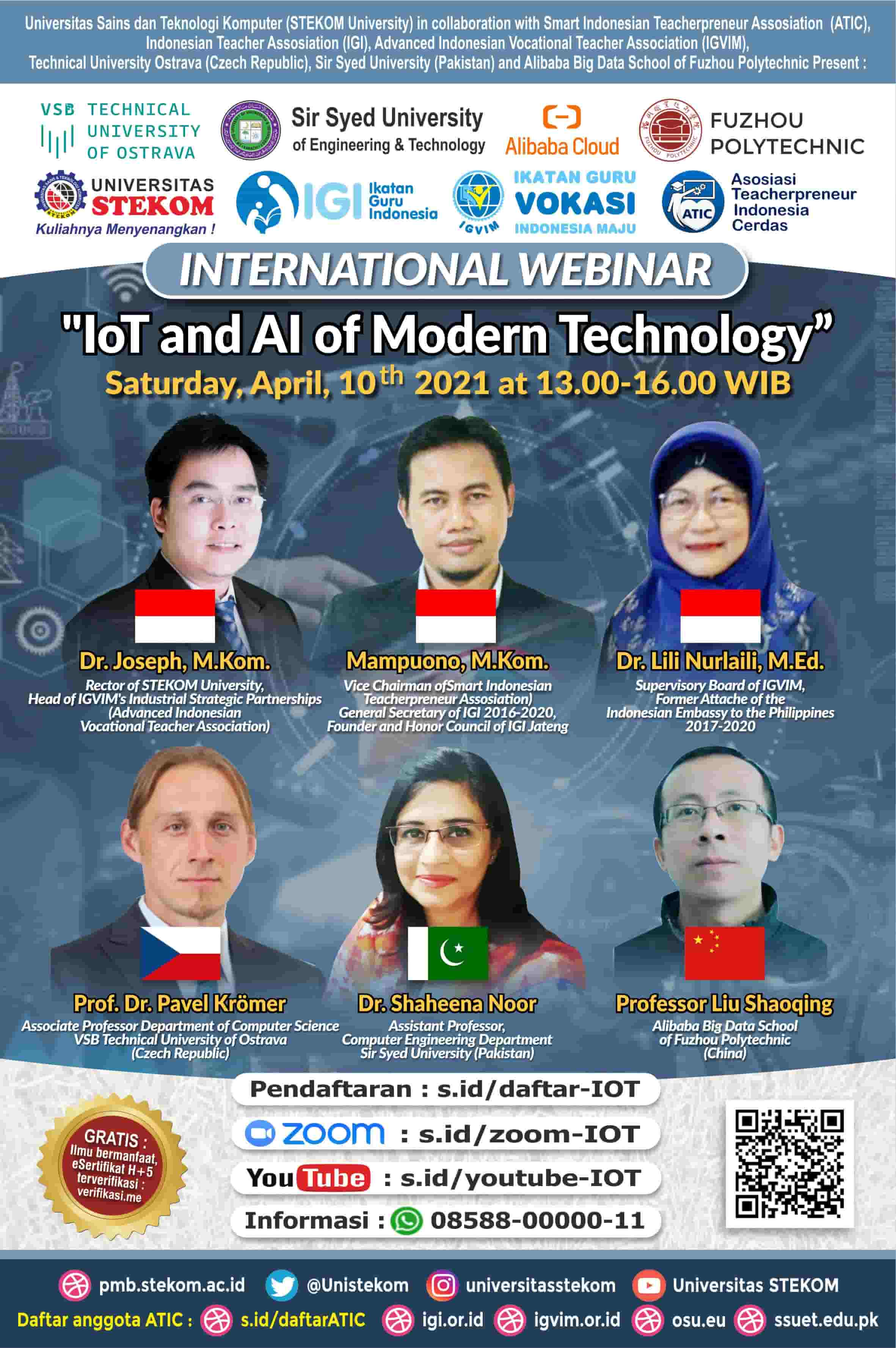
STEKOM University international webinar on the development of IoT and AI in the development of modern technology, with professors from czech and lecturers from Pakistan.
International Webinar
Back to News
International Webinar
Wednesday, October 12, 2022
Priyadi, S.Kom, M.Kom
0 Views