
Sequence diagram is a diagram that is used to explain and display the interactions between objects in a system in detail. In addition, the sequence diagram will also display the message or command that was sent, along with the execution time. Objects related to the operation process are usually sorted from left to right.
This diagram consists of two dimensions, namely the vertical dimension which shows time and the horizontal dimension which shows objects. Each object, including actors, has an active time which is described by a vertical column called a lifeline. Meanwhile, messages or commands are depicted as arrows from one lifeline to another.
Sequence diagrams can be used to describe a series of steps taken in response to an event to produce a certain output. Sequence diagrams are related and closely related to use case diagrams, where one use case diagram will become a sequence diagram.
The main purpose of making a sequence diagram is to find out the sequence of events that can produce the desired output. In addition, the purpose of this sequence diagram is similar to activity diagrams, such as describing the workflow of an activity, and can describe data flows in more detail, including data or behavior received or sent.
Here are some of the main components that are often used:
- Actor
The first component is the actor. This component describes a user (user) who is outside the system and is interacting with the system. In sequence diagrams, actors are usually represented by the symbol of a stick figure.
- Activation box
Next there is an activation box. This activation box component represents the time needed for an object to complete its task. The longer it takes, the activation box will automatically be longer. This component is represented by a rectangular shape.
- Lifelines
Next is the lifeline. This component is represented by the dotted line. This lifeline usually has a box containing objects that have a function to describe the activities of the object.
- Objects
The next component is an object. This object component is described as having a box shape containing the name of the object with an underscore. Usually objects serve to document the behavior of an object on a system.
- Messages
Finally there is a message or messages. This component is to describe the communication between objects. Messages usually appear sequentially on the lifeline. The messages component is represented by an arrow. The heart of a sequence diagram lies in these lifeline and message components.
The above material was delivered by a presenter from Indonesia in an international visiting lecturer held by STEKOM University in collaboration with Universities from Ukraine. The title of the presentation is "Engineering in the Software Development Model". The name of the presenter is Migunani Hudayatullah, S.Kom., M.Kom. Mr. Migunanani is an active lecturer and head of the Information Systems study program at STEKOM University.
This international webinar activity is part of the implementation of STEKOM University's commitment to increase various international activities. This was done in order to realize the vision to become an international-class university. Various international activities carried out by STEKOM University continue from year to year. There are international activities that are sustainable and there are also some international activities that are not sustainable. All types of international activities are accommodated and regulated by the International department of STEKOM University.
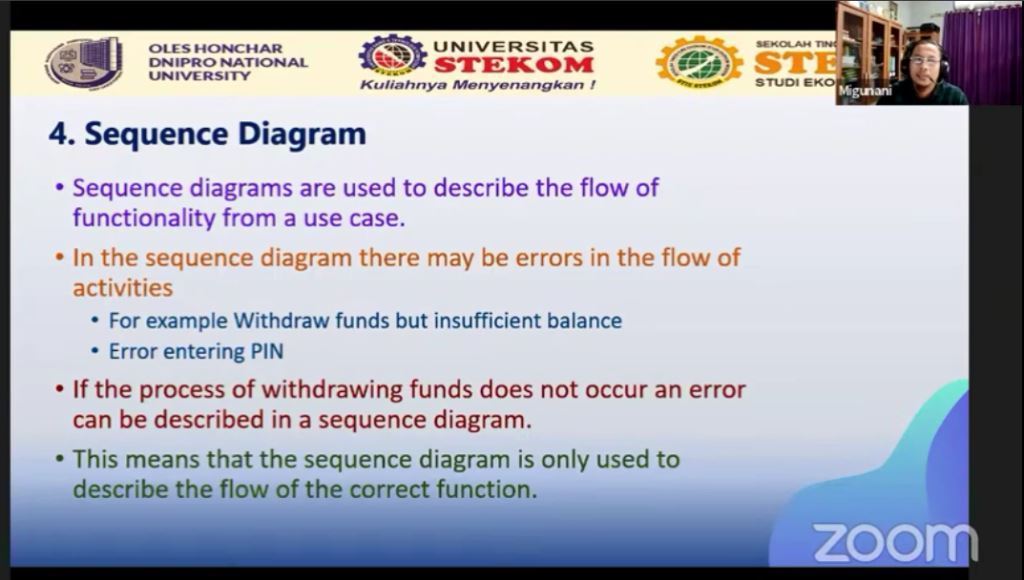
Visiting Lecturer from STEKOM University with Oles Honchar Dnipro National University (Ukraine) part 7
Visiting Lecturer
Back to News
Visiting Lecturer
Wednesday, April 26, 2023
Priyadi, S.Kom, M.Kom
0 Views