
Accelerating the green transition requires careful but decisive steps to direct financing towards more sustainable patterns of production and consumption. The Commission has undertaken a series of initiatives in this regard, including integrating circular economy objectives under the EU Taxonomy Regulation44, and undertaking preparatory work on the EU Ecolabeling criteria for financial products. The Circular Economy Financial Support Platform will continue to offer guidance to project promoters on circular incentives, capacity building and financial risk management. EU financial instruments, such as the SME guarantee under the current framework and InvestEU in 2021, mobilize private finance to support a circular economy. The Commission has also proposed a new resource for the EU budget based on the amount of non-recyclable plastic packaging waste.
The STEKOM University international webinar presenter who delivered the material was Veleriia lymar from Ukraine. He is a Doctor in economics. His academic functional position is Associate professor. At his campus, Mr. Veleriia served as Acting head of international relations and foreign policy department. The campus where he is domiciled is 'Vasyl' Stus Donetsk National University, Ukraine.
The title of the presentation delivered by Mr. Veleriia was "Analyzing a New Circular Economy Action Plan". At the beginning of his presentation, Mr. Veleriia explained about the new circular economy action plan developed by the European commission. The European Commission adopted a new circular economy action plan (CEAP) in March 2020. It is one of the key building blocks of the European Green Deal, Europe's new agenda for sustainable growth. The EU's transition to a circular economy will reduce pressure on natural resources and will create sustainable growth and jobs. It is also a prerequisite for achieving the EU's 2050 climate neutrality target and for halting biodiversity loss.
The webinar activity is part of the implementation of STEKOM University's commitment to increase various international activities in order to realize the vision to become an international-class university. Various international activities carried out by STEKOM University continue from year to year. There are international activities that are sustainable and there are also some international activities that are not sustainable. All types of international activities are accommodated and regulated by the International department of STEKOM University.
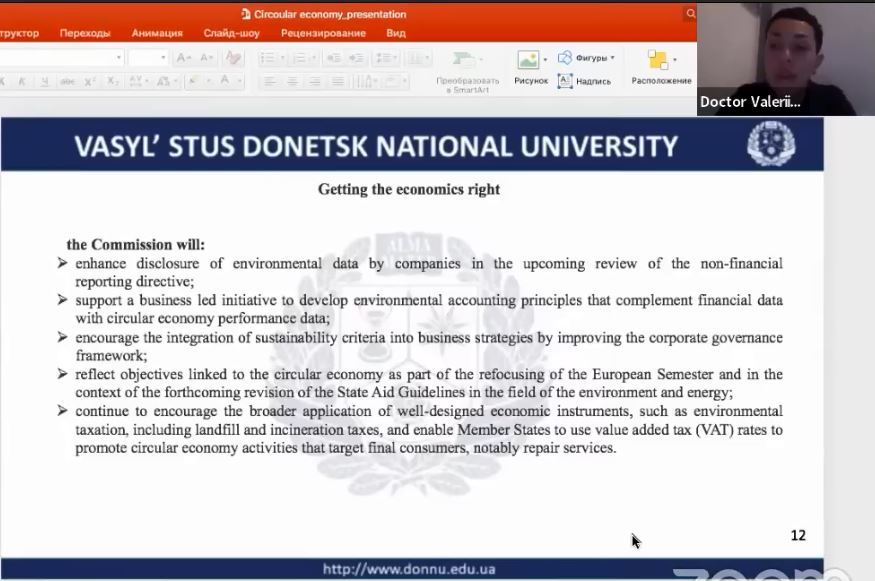
To achieve true economic goals, the European Commission must establish clear and firm steps. The steps to be taken by the European Commission are:
- increasing the disclosure of environmental data by companies in the review of forthcoming non-financial reporting directives;
- support business-led initiatives to develop environmental accounting principles that complement financial data with circular economy performance data;
- encourage the integration of sustainability criteria into business strategy by enhancing the corporate governance framework;
- reflects objectives related to the circular economy as part of the European Semester refocusing and in
the context of the forthcoming revision of the State Assistance Guidelines in the environmental and energy fields;
- continue to push for wider adoption of well-designed economic instruments, such as environmental taxation, including landfill and incineration taxes, and enable Member States to use value added tax (VAT) rates to promote circular economy activities targeting end consumers, especially repairs service.
The clarity of these steps will provide certainty for interested parties in planning their business. Their business goals and targets will be directed towards achieving the expected profits while the environmental protection strategy by the European Commission will achieve success.
Webinar International 2022 - The advantages of green engineering part 7
International Webinar
Back to News
International Webinar
Wednesday, November 30, 2022
Priyadi, S.Kom, M.Kom
0 Views