
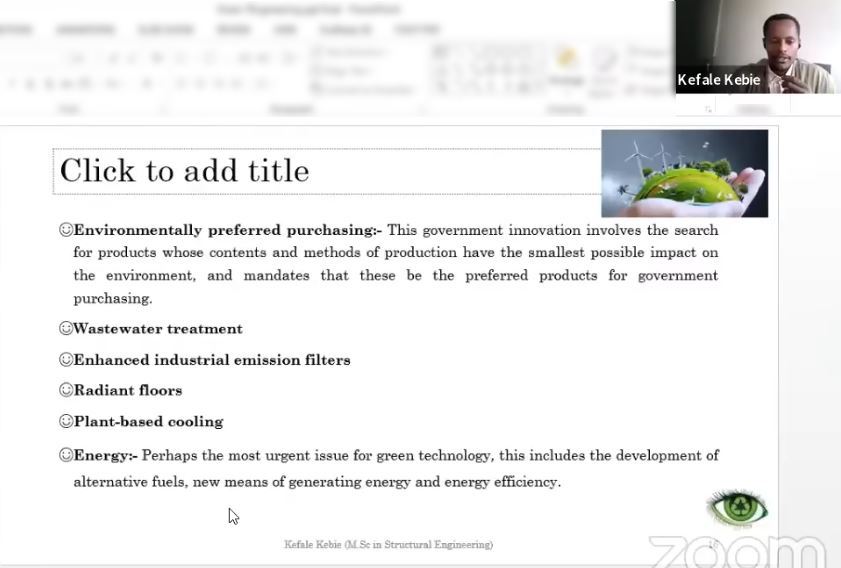
'Green' buildings are buildings which, in their design, construction or operation, reduce or eliminate the negative impacts, and can create positive impacts, on our climate and natural environment. Besides green buildings, another green engineered subject area is green buying. This government innovation involves finding products whose contents and production methods have the least possible impact on the environment, and mandating these to be the product of choice for government purchases.
Other waste water treatment green engineering subject areas. Waste treatment is a mechanism for removing contaminants dissolved in water through several mechanisms. In general, this can be done in 3 ways, physical processing, biological processing and chemical processing.
The mechanism of the 3 ways above is carried out with the aim of stabilizing and eliminating pollutant substances that can have a negative impact on the quality of environmental health. Especially for someone when the water used is not hygienic.
Various disease threats often arise from polluted air sources. Starting from diarrhea, vomiting and so on. For this reason, it is important that knowledge of water treatment can minimize this risk, in addition to maintaining clean water sources. The following is an explanation of 3 methods or ways of purifying wastewater that can be done independently.
Physical Wastewater Treatment. This method is carried out in stages with a water collector concentration medium. You do this by making a well that is used to collect water discharge. Furthermore, the filtering process is carried out periodically with coarse screening (to take dirt in a larger form).
Furthermore, the filtering process is carried out by the sand capture process or commonly known as the Grit Chamber. Furthermore, the precipitation process is carried out twice to ensure that pollutant substances are no longer in the air.
Biological Wastewater Treatment.
Biological wastewater treatment process can be done in three ways. Among them by processing Aerobic, Anaerobic and a combination of both. Aerobic treatment is carried out with media containing oxygen. While anaerobic can be done in media without oxygen.
Aerobic wastewater treatment is carried out using arration pond media. The pond provides a medium for the growth and development of decomposing bacteria. Oxygen decomposing bacteria will make the air filtering process run biologically, so that the air can be used again.
Anaerobic process is carried out with closed aeration media. Because the bacteria that are used can thrive in an environment without oxygen. The waste treatment process is basically almost the same and runs biologically.
To get the benefits of both, the wastewater treatment process can be carried out in combination. With oxygenated aeration media and in the next room using closed media without oxygen.
Chemical Wastewater Treatment.
As the name suggests, this process goes on chemically with at least three purification processes. Among them neutralization, precipitation and coagulation and flocculation. Compared to the two methods above, this method is more complex by adding chemical concentrates.
The STEKOM University international webinar presenter who delivered the material was Kefale Kebie Bishaw who has an M.Sc academic degree in Structural Engineering. He is also a lecturer and researcher at Debre Tabor University which is located in the city of Debre Tabor, Country of Ethiopia. STEKOM University has collaborated with the University several times. This time the international activity being held was an international webinar entitled "Advantage of Green Engineering".
The title of the presentation delivered by Mr. Kefale was "Advantage of Green Engineering / Technology". At the beginning of his presentation, Mr. Kefale explained the outline of his presentation. The outline presented by Mr. Kefale included the following points:
- What is Green Engineering?
- Green Engineering Category,
- Green Engineering Push Factor Pen,
- Benefits and Some Limitations,
- Conclusions and recommendations.
The webinar activity is part of the implementation of STEKOM University's commitment to increase various international activities in order to realize the vision to become an international-class university. Various international activities carried out by STEKOM University continue from year to year. There are international activities that are sustainable and there are also some international activities that are not sustainable. All types of activities are accommodated internationally and regulated by the International department of STEKOM University.
International Webinar 2022 - The advantages of green engineering part 14
International Webinar
Kembali ke Berita
International Webinar
Senin, 5 Desember 2022
Priyadi, S.Kom, M.Kom
0 Dilihat