
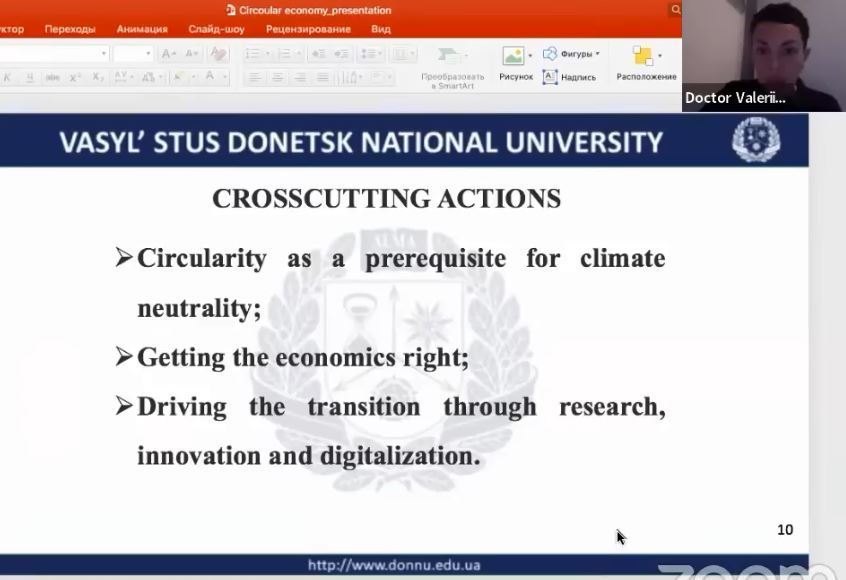
The European Commission adopted a new circular economy action plan (CEAP) in March 2020. It is one of the key building blocks of the European Green Deal, Europe's new agenda for sustainable growth. The EU's transition to a circular economy will reduce pressure on natural resources and will create sustainable growth and jobs. It is also a prerequisite for achieving the EU's 2050 climate neutrality target and for halting biodiversity loss.
The new action plan announces initiatives throughout the product life cycle. It targets how products are designed, promotes circular economy processes, promotes sustainable consumption, and aims to ensure that waste is prevented and the resources used are kept in the EU economy for as long as possible.
It introduces legislative and non-legislative measures targeting areas where action at the EU level brings real added value.
The STEKOM University international webinar presenter who delivered the material was Veleriia lymar from Ukraine. He is a Doctor in economics. His academic functional position is Associate professor. At his campus, Mr. Veleriia served as Acting head of international relations and foreign policy department. The campus where he is domiciled is 'Vasyl' Stus Donetsk National University, Ukraine.
The title of the presentation delivered by Mr. Veleriia was "Analyzing a New Circular Economy Action Plan". At the beginning of his presentation, Mr. Veleriia explained about the new circular economy action plan developed by the European commission. The European Commission adopted a new circular economy action plan (CEAP) in March 2020. It is one of the key building blocks of the European Green Deal, Europe's new agenda for sustainable growth. The EU's transition to a circular economy will reduce pressure on natural resources and will create sustainable growth and jobs. It is also a prerequisite for achieving the EU's 2050 climate neutrality target and for halting biodiversity loss.
The webinar activity is part of the implementation of STEKOM University's commitment to increase various international activities in order to realize the vision to become an international-class university. Various international activities carried out by STEKOM University continue from year to year. There are international activities that are sustainable and there are also some international activities that are not sustainable. All types of international activities are accommodated and regulated by the International department of STEKOM University.
The measures to be introduced under the new action plan aim to: make sustainable products the norm in the EU; empower consumers and public buyers; focus on the sectors that use the most resources and where there is potential; high circularity such as: electronics and ICT, batteries and vehicles, packaging, plastics, textiles, construction and buildings, food, water, and nutrition; ensure less waste
making circularity work for people, regions, and cities; leading global efforts on a circular economy.
For biodegradable plastics and compostable plastics, manufacturers should focus investment on applications where there is a clear environmental benefit from using the plastic. EU-funded R&I, including the Circular Bio-based Europe partnership and the EU Mission 'Restore our Ocean and Waters by 2030', deal with bio-based plastics made from sustainably sourced biomass, particularly secondary biomass. Biomass is organic, non-fossil material derived from biological sources which includes residues from agriculture, forestry and aquaculture and fisheries, special crops and forestry, micro-organisms, and bio-wastes.
Achieving the goals of the European Green Deal requires a circular and sustainable bioeconomy. Research and innovation (R&I) is playing a critical role in enabling and accelerating this transition, opening up new ways to produce and consume that respect the boundaries of the planet and life on earth.
Webinar International 2022 - The advantages of green engineering part 6
International Webinar
Kembali ke Berita
International Webinar
Rabu, 30 November 2022
Priyadi, S.Kom, M.Kom
0 Dilihat